
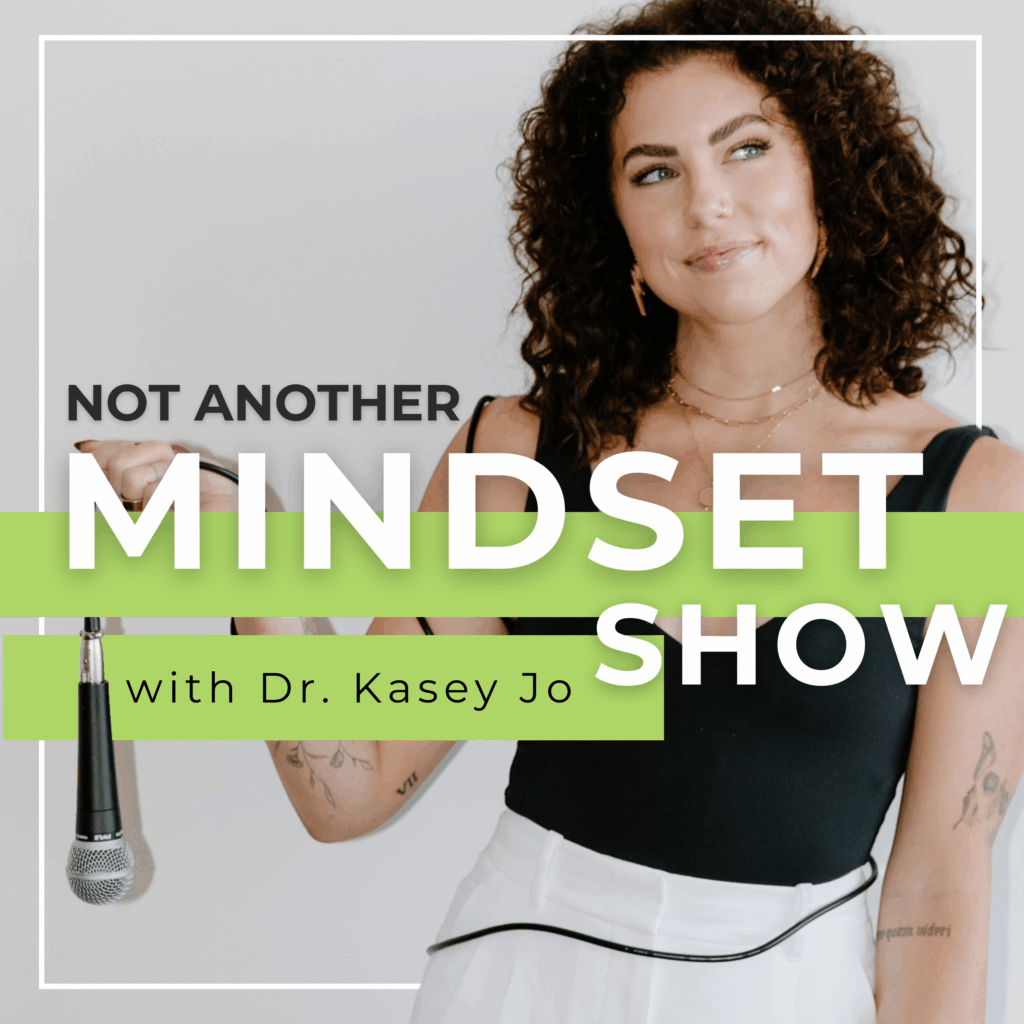

I challenge you to rethink how you and your clients use this phrase.
Saying “Everything happens for a reason” may seem like an easygoing way to live, but what if it’s actually holding you back?
In this episode, I discuss the psychology behind believing in this phrase. I share the pros and cons of following the “everything happens for a reason” mindset and go into how you can find balance with the phrase.
You definitely aren’t the only one saying this to yourself. The odds are that you have some clients who are speaking to themselves this way, too, and you’ll have some tools to help them after listening to this episode.
And if you feel like you always have some clients that just keep self-sabotaging and can’t stick to the plan, no matter what you try, you’ll want to get your hands on my 5 FREE lessons in behavior change and mindset. These lessons will help you coach your clients to overcome all-or-nothing thinking and fixed mindsets, stop getting in their own way, develop more self-control, and increase motivation and follow-through.
Episode Highlights
>>(2:01) Understanding the phrase “everything happens for a reason,” and taking a psychological perspective on it.
>>(6:24) The benefits of believing that everything happens for a reason.
>>(10:23) The not-so-great thing about believing that everything happens for a reason.
>>(17:42) I don’t hate the phrase. I think there needs to be some balance in how we use and interpret it.
Tune in to the full episode to get my thoughts on and the psychology behind this common phrase.
Rate, review, and subscribe to my podcast.
If you enjoyed this episode, I’d be incredibly grateful if you could rate and review the show on your favorite platform. Your feedback helps me improve and allows others to discover the show. I want to hear from you whether you’re loving the insights or have suggestions on how I can make the show even better!
Simply scroll down to the review section on Apple Podcasts, Spotify, or wherever you listen, and leave your thoughts. Your support means the world to me and helps me continue to bring you more of the content you enjoy.
Links From the Podcast
Want me to answer your questions on my next Q&A episode? Drop your questions here!
More podcast episodes from Not Another Mindset Show
Health Mindset Coaching Certification Instagram
Getting started with the Health Mindset Coaching Certification (5 FREE lessons included!)
Episode’s Full Transcript
I believe this is, this is my podcast, so I’m allowed to share my beliefs. Okay. I believe that there is a potential that having this belief can lead to. Passivity and inaction in some cases. Hello my friends, and welcome back to not another Mindset show. I’m your host, Dr. Casey Jo. My goal with this podcast is to take the science of mindset and behavior change and distill it down into actionable takeaways for you.
Together we’re gonna unpack research around motivations, self-sabotage, willpower, and so much more, and we’re going to take all of that and translate it into strategies you can immediately apply. To your health, fitness, relationships, business, marketing clients, all of the things. But just to be clear, it’s not all serious and sciencey around here.
We’re gonna have a ton of fun too, and I’m so excited to share all of this with you. All right, let’s go ahead and get into the episode. Hello my friends. Welcome back to not another mindset show. Today we are talking about a very commonly held belief, commonly said phrase. Everything happens for a reason.
I will tell you, I have said this many a time in my life, and this is not about to be a podcast episode about how terrible it is for you to be thinking this way. However, there’s, there’s some nuance I want to introduce to this belief that everything happens for a reason, and I think if we can hold onto this belief while also holding onto the nuance, it can be even more.
Productive and helpful. And I know I’m talking to a lot of health and fitness coaches, a lot of business owners on this podcast, and also just people who are interested in improving themselves, their own mindset better understand psychology in general. So I’ll probably throw out some examples that are both relevant to the health and fitness coach, to your clients and also to yourself.
So. First, we need to kind of understand this phrase. Everything happens for a reason. I think it’s mostly tossed out when something goes poorly, right? I don’t think this phrase is actually ever used if something goes well, because if it went well, then we don’t need to have an excuse for why it went well.
We’re just celebrating that it went well. But instead, if something goes poorly, you get broken up with you lose your job. That projects you’ve been working on, somehow your computer didn’t save it. Like, oh, everything happens for a reason, right? Like, I, I need to rewrite it so it’ll be better the next time.
Um, like that can be really helpful in the moment to quell any anxiety or negative feelings. But yeah, we don’t ever really use it in a positive sense. Like I. Let’s say, okay, I got my PhD in 2019. People aren’t gonna be like, congratulations. Everything happens for a reason. But if I were to have taken an extra five years to get my PhD done.
Because I didn’t get funding or I changed my ideas of what research I wanted to do and I was like, damn, that took me 10 years to get this degree. But you know, everything happens for a reason. There’s a reason I wasn’t ready to go out into the world yet. I needed to like research those specific topics.
Really. That’s number one thing I just want you to think about, like why is it that we, this will make sense into what I’m, what else I wanna say too? Why is it that we need to. Make ourselves feel better by believing that there is a reason behind things didn’t, why things didn’t go the way that we wanted them to.
And I think like from a psychological perspective, this actually relates a good bit to something called attribution theory. And that theory essentially explores how people interpret and explain the causes of events or specific outcomes. So. This theory kind of differentiates between either internal attribution or external attribution.
So it was either like personal responsibility or outside forces, or let’s call it fate, which this is like really kind of a conversation about. Fate, right? Like it happened because it had to and we had no control over it. No personal responsibility. So if we’re thinking about it from an attribution theory perspective, everything that everything happens for a reason is actually in some way.
And we’ll get into this. ’cause I do think that there’s some, some aspects of this belief that we need to get into that aren’t necessarily positive. And I will talk about that. But I think that that’s where that kind of. Starts to take form is that we are placing control in fate in everything happens for a reason rather than maybe recognizing our own personal power, but, okay.
So an example using attribution theory to describe this phrase and this belief sys, is it a belief system? It’s definitely a belief. Um, for example, if you succeed at some sort of goal. And from that, you may either attribute that to your hard work and your effort and your dedication over time, which would be an internal attribution.
Or you might, you know, if someone says like, congratulations on this goal that you achieved. You might say, ah, you know. There’s a lot of people who’ve done this before, or, yeah, I had a lot of luck, or I had a lot of support. So you’re actually attributing your success to outside forces in that case rather than yourself, which I guess we could also, you know, there’s another layer to this of people just not wanting to accept compliments and things like that, but.
That’s kind of like, I almost like the ugly side of everything happens for a reason, and I promise I’m gonna bring this all background where it’s going to make more sense, but you’re actually watching my brain try to tease this apart in real time. So I guess let’s start with like the pros of believing that everything happens for a reason.
We as humans are meaning makers and we really have motivation to make sense. Of things to assign meaning to things. And we are entirely in charge of deciding what things mean to us and how we want to make sense of things. And it actually, it actually kind of reminds me of some of Victor Frankl’s work on, he has like, the, the human search for meaning is his big like premise, the thing that he has talked about.
What is, um. It is, it’s like logo therapy, I think is his theory of the human search for meaning being a central force for us, like a central, like motivational force rather. So a central motivational force that we have as humans is to find meaning in things. So. During difficult times, like certain setbacks or challenges or difficulties, or again, we are talking like breakups or business failures or whatever.
We have a central motivation. This would be like Victor Frankl’s, um, perspective. We have a motivation, a drive to make sense for it of it and find meaning in it, which then can give us like a sense of. Purpose and drive our recovery from that setback or heartbreak or business failure. Because now it’s, well, everything happens for a reason and maybe there is a reason.
Even if I don’t know it yet, then I will be revealed later. Which I think we’ve all had experiences where that absolutely happens too. Right? And I think it’s far healthier to believe that, oh, that failure, that setback had a purpose. It had a, it has meaning even if I don’t see it yet. So that’s kind of a growth mindset perspective.
And it also just generally encourages resilience and growth. And we actually have research that supports how stress related growth can actually lead to a positive psychological change. So that’s because of adversity. So you can’t have this like stress related growth without. The adverse event. So it’s sort of like you don’t know the light until you’ve seen the dark type of situation.
So for instance, maybe you’ve experienced, again, breakup, business failure. You have a client who maybe lost like a competition of some sort. Your client might reflect on the experience and emerge with a greater mental toughness and a renewed focus on where they need to improve and get really excited about what needs to change.
And like, I mean, we’re not just talking growth mindset here. So same with like breakups. Like what are you learning about what you want in a person who’s the best fit for you? Business failures. What did you learn from those mistakes? What could you have done differently? Do you need to pivot or do you just need to make some adjustments?
And if those things didn’t happen, then you wouldn’t have that information. So yeah, everything happens for a reason, and we can see where that belief is helpful from a resilience perspective, a growth mindset perspective, a. Feeling of purpose and meaning behind our setbacks and failures. So great. Those are all helpful things.
We love it. We love it. But what about the cons? What about the cons of believing that everything happens for a reason?
I believe. This is, this is my podcast, so I’m allowed to share my beliefs. Okay. I believe that there is a potential that having this belief can lead to passivity and inaction in some cases. And this actually, I wrote a bullet point down here on my notes, my outline, to keep me on track so I don’t go too far in too many tangents.
Um, learned helplessness theory. This is developed by Martin Seligman. There’s a really good chance, you’ve probably heard of this before, but it’s essentially the idea that repeated exposure to uncontrollable events can lead individuals to feel powerless to change their situations. So if you’ve frequently had situations where things feel out of your control, you eventually just give up because what’s the point?
If I can’t do anything about it, then I’m just. I’m gonna let things continue to happen to me, or let fate tell me the direction of where I’m going to go. So this could happen with your clients. If they are consistently facing setbacks and are really struggling, they might stop trying to achieve their goals altogether because they believe they have no control over their outcomes.
But obviously if we stop trying, then you’re definitely not going to achieve the goals that you’re seeking. So. If we just say, you know, everything happens for a reason, there is that chance that if you have that belief held so strongly that you actually develop a learned to helplessness over time.
Because if everything just happens for a reason and those reasons are out of your control and fate is, has the final say, then what’s the point of trying in the first place and in action? Passivity, those things are not gonna get you any closer to your goals. Or your clients for them to get to their goals.
I do think another con here is that it could be overlooking personal responsibility and agency. And we talk a lot about autonomy on the podcast, and autonomy and agency kind of go hand in hand. So for instance, self-efficacy is such. An important variable in the equation of behavior change, the behavior change equation and self-efficacy is essentially this idea that you believe in your ability to be successful, to continue doing certain behaviors, even in the face of challenges and setbacks and hardship.
So if we’re just kind of sitting back and saying, you know, everything happens for a reason, what will be will be okay. Rah rah. Um. Then that is effectively saying, I don’t have the power, I don’t have the control. Fate does everything else does, the universe does. God does whatever. So we’re also effectively not enhancing self-efficacy because it’s like, okay, well if things are challenging and hard, it can be really easy to just like sit back and go, okay, well that’s not meant for me then, and everything happens for a reason.
What will be will be type of mentality. And that overlooking of personal responsibility I think gets lost there because yeah, sure, things can happen for a reason and that can make us feel good. But what if, what if some aspect of what happened could have been controlled? But instead of going back and reviewing, reviewing the tapes and seeing, okay, what happened?
Could I have done something differently? What do I need to know for next time? What can I learn from this? You just slap a label on it and the label says everything happens for a reason. So I do think in some cases it can go too far in that you’re failing to see where you do have control, what you can get out of it, what you can use for the future, and just kind of like.
Looking the other direction and saying, eh, everything happens for a reason. I think also probably the, the last con that I kind of, I think of that comes up for me with everything happens for a reason, type of belief is cognitive biases. These are systematic patterns that we have as humans that are.
Relatively irrational and they can skew our understanding of causality and responsibility and overall just lead to flawed reasoning. So these cognitive biases, also cognitive distortions, um, I’m trying to think of an example. We talk a lot about cognitive biases and distortions in HMCC level two. That’s level two of the health mindset coaching certification.
It’s like advanced strategies and. One that comes up a lot that we talk about, that shows up with our students is heaven’s reward fallacy. And it’s this belief that if I put in the effort and I make sacrifices and I do all of the things, then I am due for a reward that I will just get the thing that I am after.
The reality is sometimes you can try really hard and. Things don’t pan out the way that they should. So the belief that, well, I did all of the things and I’m trying so hard and I’ve made sacrifices and I’m dedicated and I hired a coach, but yet I’m still not where I want to be. Like, that’s, that’s unfair.
That’s not how it should be. That’s actually not true. Sometimes you can work really hard at something and you’re actually working really hard in the wrong direction, or you have still have a missing piece, you know? So that is a cognitive distortion that we have, and that can, that’s kind of what I see here.
So, for instance, another cognitive bias is confirmation bias. So you might have a client who falls victim to confirmation bias in that. They’re only acknowledging information that supports their belief of everything happens for a reason, which then disregards any other evidence of personal agency or responsibility.
So confirmation bias is when we are only looking for evidence to support a certain belief that we have. And so if that belief is everything happens for a reason, then we are only gonna be seeking evidence to support that and not support that. Oh, I actually have control over. What happens, I have the ability to take responsibility for what happened and learn from it, and grow and develop and get better.
So if you really have this strong belief, then you’re just gonna constantly, this is confirmation bias. You’re going to be constantly looking for other pieces of evidence, other stories, other things that have happened in your life to further confirm. That belief rather than thinking about it in all these other ways that we were just talking about.
So overall, I don’t hate the belief. Everything happens for a reason. Like I said, I think it can be really helpful rather than like, listen, if you fail at something, if you have a setback, if you’re going through a hard challenging time and instead of wallowing and. Being self-deprecating, hating on yourself.
Instead of all of those things, you’re sitting in the belief of, you know what, everything happens for a reason, and I will learn what that reason is eventually, and I’m so excited and figure out what this hard time is going to do for me in the future, even if I don’t see it clearly yet. I love that for you.
I love that for you, and I think that, I think that’s so powerful. However. I just don’t want you or your clients or anyone else to be falling prey to the, well, fate has it. It’s sort of like a conversation of fate and free will. Um, I don’t actually have control. I don’t have to take responsibility. ’cause ultimately the universe is going to decide for me or whatever, because then that takes away your power and your agency and your.
Ability to see what you’re capable of. And if you were to apply yourself or find resources or hire people to help you or really try, then actually you get to set the stage for what’s to come. It’s not just already set for you. Per fate or what have you. So, okay, this was quite like a higher level sort of like philosophical discussion.
Um, and I hope you were picking up what I was putting down. For those of you who are watching on YouTube, this is Winston. This is my brother’s cat. It is crazy to me that I just like, I’ve been sitting here for hours POD podcast recording today and he literally is just jumping up. There’s nowhere else you want to be.
Besides directly in front of the camera. Oh, you want the microphone now? Yeah. This is my cue to, what are you doing? I cannot wait to grab this clip. For those of you who are listening and not watching this video, I really would encourage you to go to YouTube and just watch the very end of this, because you’ll also see me trying really hard to not let him distract me.
And then now here we are. Um, anyway, this was, like I said, kind of like higher level, just. Philosophical esque type of discussion while also inserting some psych science. Of course. Um, if you liked this episode and got you thinking and you like to see how my brain turns on some of these very random topics, um, this actually sprung up from a conversation with a friend where she said Everything happens for a reason.
And I actually challenged her on that and was like, wait, I wonder if I could turn this into a podcast episode. Um, so yeah, that’s where we’re at. Maybe I. If this was enjoyable for you to listen to, got you thinking, um, maybe I can pull some other popular beliefs or phrases and do some more episodes on that, but I’m only gonna know unless if is if you tell me, um, I won’t know that you enjoyed this unless you tell me, unless you leave a five star review and tell me how much you enjoyed this episode or any episode because when you do, I give back.
You guys know this, right? Every single month we pick one of our reviewers. To win one of my free DIY programs. So psychology of signing more clients. Transform your forms magnetic messaging, the science of self-sabotage. Any, take your pick, you get one for free if you’re chosen, and your chances of being chosen are pretty high because people.
Don’t leave a lot of reviews, and I would really, really love it if you did. ’cause that helps me. It helps the podcast grow. It helps these episodes get out to more people. Just make sure after you leave the review, that you screenshot the review and put it into the review form. Otherwise, we won’t know how to contact you.
The review form is in the show notes of every single episode, so make sure you check that out. Um, but yeah, that is all I have for you. I hope you’re now thinking about whether or not. Everything does happen for a reason or are we just trying to convince ourselves of that? But even if we are, maybe that’s an okay thing to do.
I don’t know. I could keep going, but I’m gonna stop there and let you noodle on it and I’ll see you next time. And that’s a wrap for today’s episode of Not another Mindset show. If you enjoyed today’s episode, don’t forget to hit that subscribe button so you get notified of the next one. Because if you’re anything like me, if the episodes aren’t popping up for you automatically, you’ll keep forgetting to come back to the show even if you really, really enjoyed it.
So go ahead and hit that subscribe button and make it super easy for you and of course. If you wanna see more episodes just like this one, I’d love for you to let me know by leaving a review. I know, I know it’s super annoying to do, but the few seconds that it takes means the world to me and also ensures that I can keep providing free education and value to you.
And just to sweeten the deal, I am going to be picking a random reviewer every single month to receive a free workshop or product from me if you’re looking for more free resources. Or just wanna connect, hang out, chat a little bit. Come find me on Instagram. I’m Coach Casey, Jo over there. That is where I hang out the most in the land of social media.
Alright, my friends, that is all I have for you this time. I so appreciate you being here and love to see you prioritizing your growth. I’ll see you next time.