
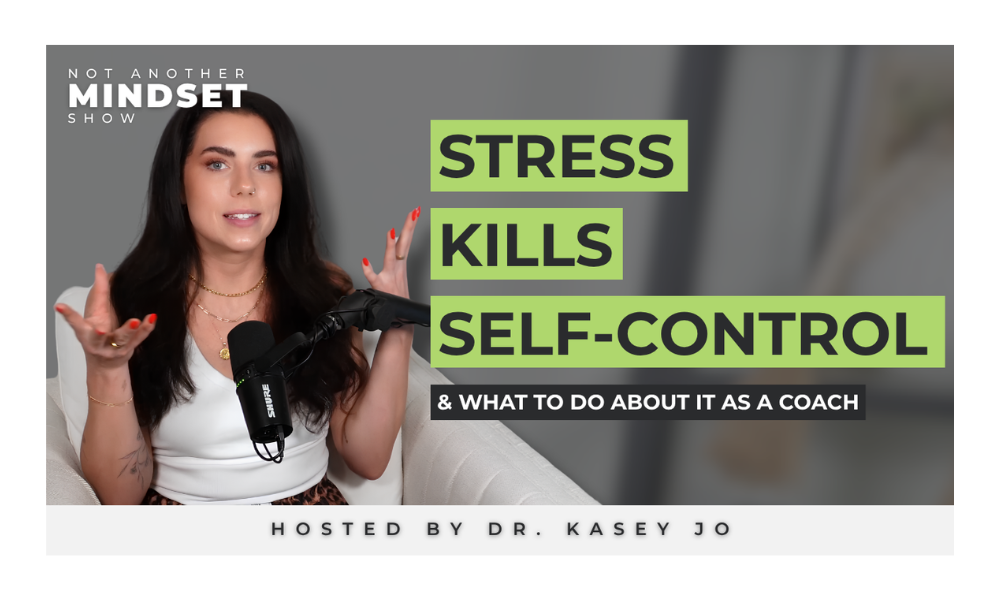
Stress and self-control compete for the same mental resources in the brain, which means a stressed-out client isn’t making excuses when they can’t follow through — they’re working with a depleted battery. When a client says “I was just too stressed to stick to things this week,” that’s not an excuse. That’s data. And how you respond to it is a coaching skill most health and fitness professionals were never taught.
In this episode of Not Another Mindset Show, I’m breaking down what’s actually happening in the brain when stress and self-control collide, why your clients fall off when life gets heavy, and the practical coaching tools (including a battery analogy you can steal) to use in your check-ins right now.
If you’ve ever had a client check in with “it was a really stressful week and I just couldn’t stay on track” and felt stuck between validating it or pushing back, this one is for you.
What You’ll Learn in This Episode
- Why stress and self-control compete for the same mental resources in the brain
- The “third option” for responding to a stressed client (that isn’t dismissing OR letting them off the hook)
- The battery analogy — and how to turn it into a coaching audit tool
- Why a client’s beliefs about stress change their actual physiological response
- Three common coaching responses that accidentally reinforce a fixed mindset (and what to say instead)
- Why praising willpower as a trait can backfire
Why Stress and Self-Control Compete in the Brain
Stress and self-control aren’t just emotionally at odds — though you can probably feel that they are. Someone who’s stressed is being asked to exert control at exactly the moment they feel like they have the least of it. There’s friction there. But biologically, they’re also competing for the same mental resources. And once you understand that, an entire world opens up in how you coach.
Here’s the way I like to frame it: one brain, two minds.
The first is your self-control mind. This lives largely in the prefrontal cortex (the big lobe right behind your forehead), where deliberate decision-making, planning, forward-thinking, and logical processing happen. It’s also where a lot of long-term thinking and growth mindset live.
The second is your stress mind, which sits more in the mid-brain regions — the amygdala is very involved here. This one is reactive, impulsive, and immediate-relief-seeking.
(Quick caveat: I’m not a neuroscientist, and the brain works in tandem with tons of connections firing everywhere. But for all intents and purposes, this is a useful way to split it up.)
You can already see the clash: deliberate decision-making versus immediate relief-seeking. When stress activates, the prefrontal cortex (your self-control area) can go a little offline, because there are only so many mental resources to go around. If you’re familiar with the sympathetic and parasympathetic nervous systems, this maps on well — stress activates fight-or-flight, while self-control requires the parasympathetic pause: plan, rest, digest. Those two systems just don’t run well at the same time.
The Battery Analogy (and Why It Matters for Coaching)
Think of your client’s mental resources like a battery. They start the day at 100%, and throughout the day it drains. Work, relationships, sleep deprivation, the decisions they make all day long — all of it pulls on that battery.
Here’s the important nuance: if a client has multiple stressors, it doesn’t mean each one is taking an equal slice. One thing might be draining 90% of the battery on its own while the rest barely register.
And self-control itself is an expensive function. It pulls from that same battery. So if the battery is already depleted, it’s not that your client doesn’t want to follow through. It’s not that they’re making excuses. It’s that they may quite literally only have 12% left to put toward the thing you’re asking of them.
(We’ll come back to this battery idea, because it makes a fantastic coaching tool, not just an explanation.)
What the Research Says About Self-Control and Beliefs
The original self-control research described willpower as something that gets depleted like a muscle: the more you use it, the more tired it gets, and the harder it becomes to exert. This idea is often called ego depletion (Baumeister and colleagues), and it’s worth noting the muscle metaphor has been debated and is harder to replicate than once thought — so hold it loosely.
What’s more interesting is what came next. More recent research (notably Job, Dweck, and Walton’s work on willpower beliefs) suggests that the depletion effect is heavily moderated by what you believe about it. The biology is real — you genuinely can’t snap back to 100% battery after a long, draining day. But your beliefs matter just as much. People who believe their willpower is a limited resource that runs out tend to show the depletion effect more strongly. People who don’t hold that belief are less affected by it.
Which, honestly, I love, because it’s one more piece of evidence for how much mindset really matters.
“I Was Too Stressed” Is Data, Not an Excuse
So here’s the reframe for you as a coach. When a client says “I was just too stressed to stick to things this week,” that’s not an excuse. That’s data.
Your job, with everything in your coaching, is to sift through the data and better understand what it means for your client and where it came from. More awareness on their end gives you more awareness, and that’s what lets you coach them effectively.
And here’s the part that matters: it genuinely doesn’t matter whether your client is “using stress as an excuse” or not. It doesn’t change your first move. Your first move is always to validate their experience and then get curious about it — not validate it and let it go, not brush it under the rug, and not jump straight into fix-it mode.
There’s an important distinction here, too. Validating that stress makes self-control harder is not the same as making it seem like a permanent, unchangeable problem they just have to suck up and live with. You’re naming the reality (yes, stress makes this harder — there’s neuroscience behind that) while signaling that it’s workable. Stress making something harder doesn’t mean failure is inevitable.
Watch Your Language: The Stress Mindset Research
This is where Alia Crum’s work on stress mindset comes in, and it’s something we spend real time on inside The Health Mindset Coaching Certification.
Crum’s findings indicate that how people perceive stress — as enhancing or as debilitating — actually affects their physiological response to it. You can think of “enhancing” as a more growth-oriented lens and “debilitating” as a more fixed one. The belief itself shapes the body’s response.
So what do you do with that? You pay close attention to the language you use with your clients, because your language shapes their mindset about stress, which in turn shapes their outcomes. It’s easy to default to language that does more harm than good without realizing it. And if you were never taught this (most health and fitness professionals never were), it’s not your fault. It’s just the gap. It’s why I’m here.
3 Coaching Responses That Backfire (And What to Say Instead)
Here are three responses I’ve heard from coaches almost verbatim, and a reworked version of each.
1. The Dismissive Fix-It Response
This is probably the most common one.
What coaches often say: “Okay, so it was a tough week, but you knew this was the plan — so what can we do differently next week to make sure the plan actually happens?”
This skips validation entirely. It implies the client just didn’t try hard enough, and it jumps straight to strategy. But if the client’s depleted brain isn’t ready to spend more energy, this falls on deaf ears — the battery is low.
Instead, try: “That sounds like it was a really full week for you. Before we talk about next steps, I want to understand what was actually pulling on you the most, because that’s going to help us build a better plan.” You validate first, then frame curiosity as something genuinely useful — not just being nice.
2. The Subtle Fixed-Mindset Response
This one is harder to catch.
What coaches often say: “I totally get it. Some people just really struggle with consistency when life gets busy. Let’s figure out what works for you instead.”
It sounds empathetic, but it quietly labels the client as someone who struggles — which reinforces a fixed mindset about self-control.
Instead, try: “It makes sense that consistency felt harder this week. That’s not about who you are — it’s about what your brain was working with. Let’s take a look at what was actually going on.” This separates identity from behavior and reframes the hard week as situational, not permanent.
3. The Well-Intentioned but Harmful Response
This one is well-meaning and can really sting.
What coaches often say: “I hear you, but honestly, stress is always going to be there. At some point you have to decide how much you really want this.”
Reading that out loud almost hurts. It frames the situation as a motivation or commitment problem and puts the client in a position of having to defend or justify their stress.
Instead, try: “Stress is always going to show up — you’re right about that. So instead of pushing through it, let’s figure out how to build a version of this that works even when life feels heavy. Are you up for that?” You acknowledge the reality of ongoing stress without weaponizing it, ask permission, and shift the framing from a willpower problem to a design problem — which is far more growth-oriented and workable.
How to Use the Battery Analogy as a Coaching Tool
Before you jump to any stress-management strategies (which isn’t what this is about), take one more step to see where your client’s battery power is actually going. Here’s how to turn the battery analogy into an audit tool:
- Describe the battery idea to your client (steal my explanation — just tell me how it goes afterward, that’s the only caveat).
- Ask permission and get their buy-in first.
- Have them list out their current active stressors.
- Ask them to assign a percentage of their battery to each one. Which gets 20%? Which gets 50%? Are they all even?
This creates a powerful reflective opportunity. It helps them become more aware and helps you understand what’s actually going on. And the goal here is not to fix the stressors — the goal is awareness.
In fact, this can be grounding all on its own. Moving stress out of an overwhelming internal process and onto paper (or into a WhatsApp message, if that’s how your client communicates) can offer some real, if temporary, relief. It lets them see it for what it is instead of just feeling the overwhelm. (Try it on yourself — it works.)
Then follow up: What came up when you went through this? Did anything surprise you? Is there any way to bring down the biggest battery drain? Are there sources of drain you have more control over than you realized?
Praise the Strategy, Not the Trait
One more language note: you can accidentally reinforce a fixed mindset about self-control without realizing it — and you may have already picked up on this.
Praising self-control as a trait (“you have such great willpower,” “great job using self-control, you’re so good at that”) sounds like a compliment, but it communicates that self-control is an innate trait you either have or don’t. From a mindset perspective, that’s harmful framing.
Instead, praise the strategy, the system, the effort, and the dedication. And help your clients build awareness around the when, where, why, and who of the moments self-control felt hard. The goal of all of this is to help clients see that self-control is not a character flaw. It’s a workable design problem — and we can absolutely work with a design problem.
This is just one small speck of the full stress and self-control model we teach inside The Health Mindset Coaching Certification — the same behavior change science that helps your clients follow through when life gets heavy.
Key Takeaways
- Stress and self-control compete for the same mental resources in the brain. When a client is stressed, their capacity for self-control genuinely decreases.
- “I was too stressed” is data, not an excuse. Your first move is always to validate, then get curious — not dismiss and not jump to fix-it mode.
- Beliefs about willpower and stress matter. Research suggests how someone perceives stress (enhancing vs. debilitating) affects their actual physiological response.
- Your language shapes your client’s mindset about stress, which shapes their outcomes. Small wording changes can separate identity from behavior.
- The battery analogy works as an audit tool: have clients map their stressors as percentages of their mental capacity to build awareness.
- Praise the strategy and effort, not the trait. Praising willpower as innate reinforces a fixed mindset.
Frequently Asked Questions About Stress and Self-Control
Why do stressed clients struggle with self-control?
Stress and self-control compete for the same mental resources in the brain. The prefrontal cortex handles deliberate decision-making and self-control, while stress activates more reactive, relief-seeking regions. When stress is high, the self-control system can go partly offline — so a stressed client genuinely has less capacity to follow through, even when they want to.
Is “I was too stressed” an excuse or a real reason a client fell off track?
From a coaching standpoint, the distinction doesn’t matter, and it doesn’t change your first move. Whether it’s an excuse or a valid reason, stress affecting self-control is real and workable. Treat the statement as data: validate the client’s experience first, then get curious about what was actually pulling on them, rather than dismissing it or jumping straight to problem-solving.
How does mindset affect stress and self-control?
Research on stress mindset (Alia Crum) indicates that whether someone views stress as enhancing or debilitating actually affects their physiological response to it. Separately, research on willpower beliefs suggests that people who see self-control as a limited resource that runs out tend to experience more depletion. In both cases, belief shapes outcome — which is why a coach’s language matters.
How can coaches help clients with self-control when they’re stressed?
Start by validating the experience and getting curious instead of jumping to fixes. Use a tool like the battery analogy: have the client map their current stressors as percentages of their mental capacity to build awareness of where their energy is actually going. Then focus on language that frames low-consistency weeks as situational design problems, not character flaws.
Should you praise clients for having good self-control?
Be careful praising self-control as a trait (“you have such great willpower”). Although it sounds positive, it frames self-control as an innate quality, which can reinforce a fixed mindset. Instead, praise the strategy, the system, and the effort the client used. This reinforces that self-control is a workable skill and design problem rather than something they either have or don’t.
Links & Resources
EP 96 — Are My Clients Making Excuses? Why That’s the Wrong Question
EP 90 — 5 Coaching Strategies for More Consistent Clients
EP 103 — The CLEAR Sales Call Framework for Coaches
Health Mindset Coaching Certification
Follow Dr. Kasey Jo on Instagram: @drkaseyjo
AUTHOR BIO
Dr. Kasey Jo Orvidas, PhD is a published mindset and health behavior change researcher with over a decade of health and fitness coaching experience. She is the founder of the mindset and behavior change coaching program: The Health Mindset Coaching Certification.