If you want to know how to sell coaching directly without feeling pushy, here’s the truth: sweaty palms and not knowing what to say usually isn’t a selling problem. It’s that you’re selling without a framework. Once you have a structure to work from, direct selling stops feeling scattered and starts feeling like a clear, confident conversation about your offer.
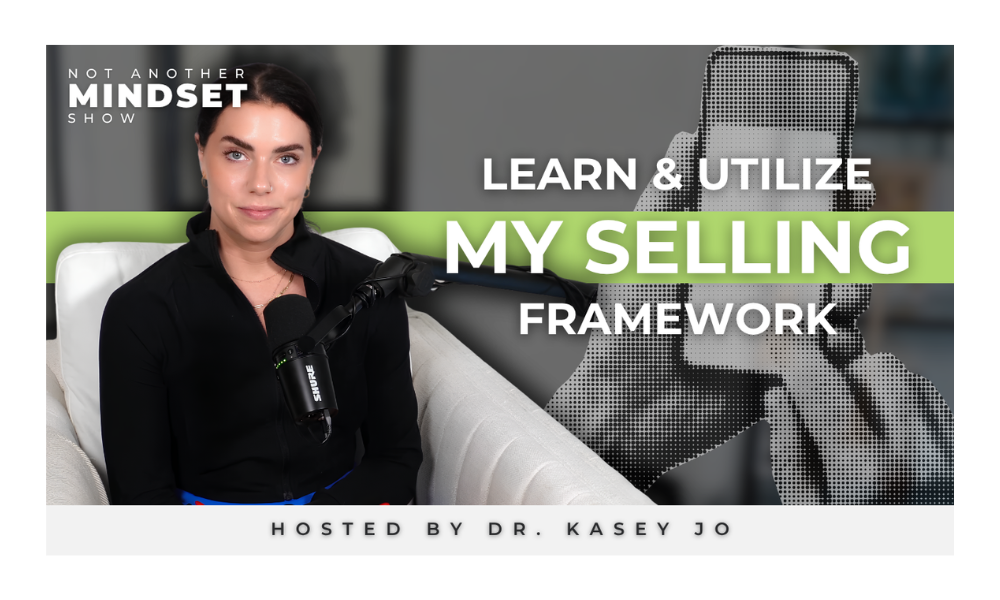
In this episode of Not Another Mindset Show (the second in the “15-Minute Framework” series), I’m walking through the SELL framework: a simple, four-part structure for selling your coaching directly and ethically, pulled from the HMCC Business Track.
If you show up consistently, build trust, and do all the indirect selling right, but freeze the moment it’s time to directly talk about your offer, this one is for you.
What You’ll Learn in This Episode
- Why “I’m not signing any clients” is often a direct-selling problem, not a marketing problem
- The difference between indirect selling (content, trust-building) and direct selling (your actual offer)
- The four parts of the SELL framework: Scarcity, Exchange, Livelihood, Likeness
- How to use real scarcity without manufacturing fake urgency
- Why information alone is no longer a selling point (and what to sell instead)
- How to use likeness so the right client self-selects in and the wrong one self-selects out
How to Sell Coaching: Indirect vs. Direct Selling
Most coaches are also business owners, which means a lot of your selling is indirect: showing up consistently on social media, sharing content, doing guest podcast episodes, building trust over time. That long game works, and it’s genuinely required (even when it feels like you’re at the mercy of an algorithm that won’t give you enough attention).
I’m doing it right now, in fact. Sitting here supporting you and showing you what’s possible with mindset and behavior change science is me selling indirectly, building belief in this kind of work and earning trust with every episode.
But at some point, you have to directly sell. You have to talk about your offer and sell it clearly, whether that’s through a launch, a sale, or a straightforward call to action. And that’s exactly where a lot of coaches get too vague, freeze, or don’t do it at all. It’s the classic “I’m not signing any clients,” and when you ask when they last directly talked about their offer, the answer is usually crickets.
So this is about how to sell coaching directly, with a framework that makes it feel clear instead of scattered. And to be clear about what this is not: it’s not about manipulating, convincing, pressuring, or forcing anyone into something they’re not right for. That’s not how we do things here. This is about communicating your offer effectively and ethically.
The SELL Framework for How to Sell Coaching
The SELL framework has four parts: Scarcity, Exchange, Livelihood, and Likeness. You won’t need all four in every piece of sales content, but you do need to know which ones tend to be missing from yours.
S — Scarcity
You’ve heard this one before: your offer is limited by time, price, or spots available. But it only works if it’s real. No fake urgency. Manufactured scarcity erodes trust more than almost anything else.
If you constantly say the price is going up and it never does, people notice. If you run a sale every single month, people start wondering why you’re always discounting and figure they’ll just catch the next one. So if your offer isn’t actually limited, don’t fake it. Find a real constraint you can use ethically.
For example, HMCC only opens for enrollment twice per year, because we run two live cohorts. That’s a real limit, so we leverage it honestly. If you sell one-on-one coaching, think about how many clients you can comfortably onboard in a month. Maybe that’s five. It might be something you never mention, but the reality is you’d feel overwhelmed past that. So it becomes: “My five coaching spots for June are open, and they’ll go fast. Get your application in ASAP.”
You don’t absolutely need scarcity. But when people are investing significant time, money, and effort (which coaching usually requires), there’s a lot of hesitation and pro-con weighing involved. A real timeline, deadline, or spot limit can help people actually move.
E — Exchange
Communicate what people are getting in exchange for their investment. Most coaches undersell this because it feels weird to list out the features and transformation of their offer. But your prospective clients can’t see value that you never make visible.
They’re handing you dollars, time, effort, commitment, and trust. Don’t take that lightly. Talk about what the exchange actually looks like, and make it clear you understand they’re giving you something too.
Make it specific and tangible, not vague outcomes like “lose 10 pounds.” Name the actual deliverables and what those deliverables make possible. That last part matters. “You get a weekly check-in with me” — so what? What does that actually give them? You know the value because you know what goes into those check-ins, but they don’t. A weekly check-in is a feature most coaches offer, so what makes yours more effective?
This includes freebies and lead magnets too — those are an exchange. And when you give something free (a lead magnet, a podcast episode, your Instagram content), ask whether it sets up the next exchange. Does it make your coaching the clear next step?
L — Livelihood
This is about how your offer affects someone’s life, emotionally and practically. Don’t just list features and benefits. Make the transformation clear. What can they expect over the next six months? Paint the picture. Future-pace them. Help them see how this genuinely changes their life, not just “you get a weekly check-in and a personalized macro plan.”
Here’s the hard truth: information alone is no longer a selling point. “We have a whole resource portal with tons of PDFs” doesn’t land the way it used to, because someone can go to ChatGPT and say “here are my macros, I’m going to Mexico for three days, I want to stay within 200 to 300 calories and have some drinks, write me a plan” — and it will. They don’t need your “how to stay on track on vacation” PDF.
Gatekeeping information isn’t the strategy in 2026. Information is ridiculously available now, especially in health and fitness. So show people the experience and transformation you provide, because that’s the part AI can’t replicate.
L — Likeness
This is about making the right person feel like your offer was made specifically for them — and letting the wrong-fit person easily self-select out. You want your messaging to filter.
Similarity is one of the most powerful elements of social proof. So a random smattering of before-and-after photos and testimonials is great if you have them, but it’s not great for filtering. You want your ideal client (that specific person with that specific problem) to read a testimonial or case study and think, “Oh my gosh, that person is just like me — so this coach can help me too.” That’s the feeling you’re after.
Likeness is also about how connected someone feels to you, and whether they feel like they’d belong in a coaching relationship with you. This is where your authenticity comes through: how you speak, how you say things, who you actually are. For example, my HMCC students come to our weekly live calls partly because they like to hang out with me and Kyra, my COO. We banter and have fun. We’re a continuing education program, but we’re not stuck-up. That personality helps from a selling perspective.
A good gut check: read your sales page out loud. Does it actually sound like you? Does it sound like you’re talking to a real person? If not, you may be missing this one.
How to Sell Coaching With the SELL Framework (Putting It Together)
These four elements work together, but you don’t need to cram all four into every piece of direct sales content. The real skill is knowing which ones tend to be missing from yours (whether that’s a sales page, a launch email, or a direct CTA to your coaching on Instagram).
Quick recap:
- Scarcity: make it real, not manufactured.
- Exchange: make the value visible, and acknowledge what they’re giving you in return.
- Livelihood: showcase the experience and transformation, not just information.
- Likeness: make the right person feel seen and like they belong with you.
This snippet comes from the HMCC Business Track, which takes the mindset, behavior change, and psychology foundations we teach at The Health Mindset Coaching Certification and applies them to sales and marketing.
Key Takeaways
- “I’m not signing clients” is often a direct-selling problem. Indirect selling builds trust, but at some point you have to clearly talk about your offer.
- Selling directly isn’t manipulation. With a framework, it becomes a clear, ethical conversation about what you offer.
- SELL stands for Scarcity, Exchange, Livelihood, and Likeness.
- Scarcity only works when it’s real. Fake urgency erodes trust faster than almost anything.
- Information alone no longer sells. AI has made information abundant, so sell the experience and transformation instead.
- Likeness makes the right client self-select in and the wrong one self-select out. Your authenticity is part of the sell.
Frequently Asked Questions About How to Sell Coaching
How do you sell coaching without being pushy?
Selling coaching without being pushy comes down to using a clear framework rather than pressure. The SELL framework (Scarcity, Exchange, Livelihood, Likeness) helps you communicate your offer honestly: real limits instead of fake urgency, visible value, a clear picture of the transformation, and messaging that helps the right client recognize themselves. Direct selling done ethically is just clear communication about how you can help.
What is the difference between direct and indirect selling for coaches?
Indirect selling is the long game: content, podcast episodes, and consistent presence that builds trust and belief over time. Direct selling is when you clearly talk about your offer and ask for the sale, through a launch, a promotion, or a direct call to action. Most coaches do plenty of indirect selling but freeze on the direct part, which is often why they struggle to sign clients.
How do you use scarcity in sales ethically?
Ethical scarcity is based on a real constraint, never a manufactured one. Examples include enrollment that only opens a set number of times per year, or a genuine limit on how many one-on-one clients you can take on in a month. Fake urgency (prices that never actually rise, constant monthly sales) erodes trust. Real limits help hesitant buyers make a decision.
Why doesn’t information sell coaching anymore?
Because information is now abundant and easy to access, especially in health and fitness. Tools like ChatGPT can generate meal plans, macro targets, and strategies instantly, so gatekeeping information no longer differentiates you. What still sells is the experience, accountability, and transformation you provide as a coach, which AI and free content can’t replicate.
What makes a coaching testimonial effective?
Effectiveness comes from similarity, not volume. A prospective client should read a testimonial or case study and think, “that person is just like me.” When your ideal client (with their specific problem) sees someone like themselves succeed, it builds belief that you can help them too. That’s more powerful for attracting the right people than a large but generic collection of before-and-after photos.
Links & Resources
The CLEAR Sales Call Framework for Coaches | EP 103
How to Sell Coaching Services Without Feeling Slimy | EP 98
Money Mindset Sales Objections: What Coaches Must Know | EP 99
Health Mindset Coaching Certification
Follow Dr. Kasey Jo on Instagram: @drkaseyjo
AUTHOR BIO
Dr. Kasey Jo Orvidas, PhD is a published mindset and health behavior change researcher with over a decade of health and fitness coaching experience. She is the founder of the mindset and behavior change coaching program: The Health Mindset Coaching Certification.