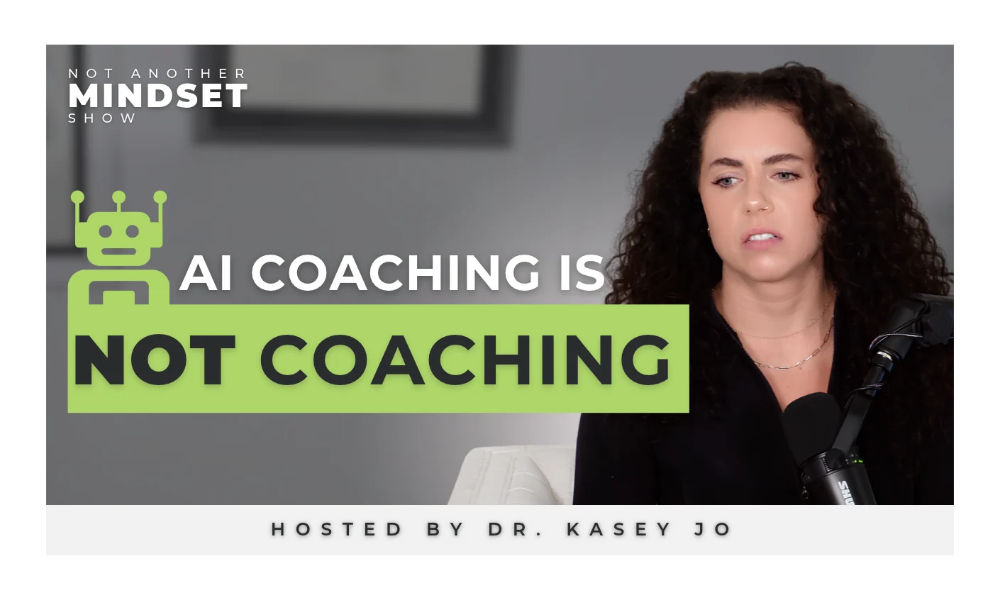
Should health coaches use AI? My honest answer is yes, for admin and data, but not for actually coaching your clients or writing their check-in responses. Once AI is writing those, it’s basically running the coaching relationship. And the coaching relationship is the coaching.
So here’s what’s going on. A popular coaching software just rolled out a really big AI integration, and if you’re on social media at all, you’ve probably seen coaches talking about it. A lot of it is backlash, honestly, and it’s coming from the coaches who really care about the quality of their work. I get it.
I’m not going to name the company, because this isn’t about them. Most of you know who I’m talking about anyway. What I care about is where the whole coaching industry is heading.
I spent some time on their sales page. It says one coach can now manage hundreds of clients on their own, check-ins write themselves, and the admin runs overnight while you’re off the clock. There’s also a testimonial where a coach says they feel like they’re cheating. Which, okay, if you’re the software, I guess that’s a great testimonial? But didn’t we all learn in first grade that cheating isn’t a good thing?
The question I kept coming back to while I was prepping this episode was this one. At what point does “scale your coaching” just mean you’ve stopped coaching altogether?
What You’ll Learn in This Episode
- Two lines from the same sales page that can’t both be true
- Why managing 200 clients and coaching 200 clients are very different things
- The AI tools I actually think are great for coaches
- What happened when my own AI made up research and tried to pass it off as real
- Why a lot of coaches reach for AI for reasons that have nothing to do with time
- What an AI position statement is, and why I think every coach should have one
Can One Coach Manage Hundreds of Clients With AI?
You can manage hundreds of clients with AI, but you can’t actually coach them.
Here’s the thing that made me stop scrolling. On the same features list, there are two lines I want you to read back to back.
The first one, about their automated check-in responses, says you review and adjust before anything is sent, so the message still reflects your own judgment. A few lines later, it says you can scale to hundreds of clients autonomously.
I literally read that and said, “HUH??”
You can’t have both. If you’re reviewing every message, adjusting every response, and thinking about that client’s past check-ins and what to ask them next, that does not scale to hundreds of clients for one coach. So either it’s autonomous, or you’re actually doing all of that. Pick one.
Let’s Do the Honest Math
Let’s say you have 50 clients right now and this software helps you get to 200, in the same number of hours each week. That’s the picture they’re painting. The only way that works is if the human part of your coaching shrinks to basically nothing. That review step feels like it’s in there to make the whole thing feel okay. But be honest. With 200 clients, are you really reading every response, checking past check-ins, and thinking hard about what to ask next? You’re not.
And if you’re just reviewing 200 AI check-in responses, my friends, that is not coaching.
I’d say the same thing even without AI, by the way. I know some coaches somehow do work with 100 to 150 clients. But I’d argue that at that number, you’re probably not coaching each person as well as you could.
Managing Clients vs. Coaching Clients
This is the part that actually gets me a little upset. With this software, they’ve shown you can manage 200 clients on your own. They haven’t shown anything about effectively coaching 200 clients, because you can’t. You literally can’t do it.
What’s happening is coaching is quietly being redefined as management. I don’t think that’s what coaching was ever supposed to be.
My team and I use AI in our business. But we use it for efficiency. We don’t use it to mentor our students or respond to our people. Honestly, it makes me feel kind of icky even saying that out loud. Efficiency isn’t what gets sacrificed when AI takes over the coaching. What goes is the depth, the human read on someone, the connection. And in this case, that’s the whole job.
Where Health Coaches Should Use AI
I need to say this because it probably doesn’t sound like it right now. I’m not an AI hater. AI actually helped me organize my thoughts for this episode. Some of the tools in this rollout seem really freaking cool, too.
Imagine pulling together a whole year of client data and getting a synopsis of what changed, maybe broken down by quarter. I don’t know if that’s exactly what this software does, but that could be awesome. Our little human brains can’t hold all of that, especially across a whole roster of clients.
I’d also love something that flags patterns you might miss, like language a client keeps using or things that keep them stuck after months of working together. I don’t know if that exists yet. Someone please build it.
They also have a photo-to-macros feature, where you snap a picture of your food and get guesstimated macros. My friends and I have been talking about that since like 2015. It’s not going to be perfectly accurate, but hello, it’s here.
And any admin support? Love that. If AI gives you two hours back in your week that you’d otherwise spend moving data around, so you can be more present in your real life, amazing.
That’s the right way for health coaches to use AI.
AI in service of the coach, not AI as the coach.
Why AI Can’t Replace a Health Coach
AI can’t replace a health coach because it’s confidently wrong in ways only an expert can catch.
I want to show you my cards here, because I use AI almost every day.
This year we fully updated HMCC, every module, tons of new worksheets and resources, and AI helped with a lot of that. We have what we call Claudia. She’s been trained heavily on our brand voice, our messaging, our audience, my writing and thinking style, and hundreds and hundreds of hours of real coaching material from six years of doing this. I’ve even trained her to push back on basically everything I say instead of just agreeing with me.
…And she still fed me incorrect information.
When My Own AI Made Up Research
When I was using her to help look for updated research for the HMCC material, I kept getting extrapolations dressed up as research findings. Really convincing ones. I’d have to ask six more questions to get to the bottom of it, like “Are you sure? Are you sure?” And over and over, Claudia would come back with some version of, “You’re right, I don’t have anything for that. I made it up. I’m sorry.”
GIRLLL, get it together!!
Here’s why I’m telling you this. I know this research really well, from my PhD and from more research articles than I want to count. That’s the only reason I caught it. I couldn’t confidently use AI like this in any area where I’m not an expert. If you hand that same tool, the one my team and I built and have been adjusting for a year, to someone without that background, they wouldn’t catch those errors. It would actually feel more trustworthy to them, because it came from me.
That’s the whole problem with AI as a coach, in one story. It’s confidently wrong, really convincingly wrong, and it takes an expert to see it. So the human can’t leave the loop. Once they do, the quality doesn’t just slip. It becomes wrong, in a way the person using it can’t even see. That’s dangerous.
Should Health Coaches Use AI to Respond to Client Check-Ins?
My answer is no. Every time you let AI answer a client check-in for you, you’re robbing yourself of the practice you need so you don’t have to lean on it every time.
I also think, if we’re being really honest, a lot of coaches aren’t reaching for AI to save time. They’re reaching for it because they don’t trust themselves to respond well enough. Maybe a client keeps self-sabotaging. Maybe it’s a tougher health case, like gut stuff, and they plug it all into AI and it says, “Sounds like SIBO.” Next thing you know, they’re telling their client they have SIBO. Dangerous.
And I get it. Responding to a client who’s struggling week after week is hard, and not knowing what to say is uncomfortable. If you don’t fully trust yourself, AI feels like a safety net. But that safety net is full of really big holes.
I’ve tried it. I’ve pasted check-ins into AI and asked what strategies would help a client who’s self-sabotaging. Not every word it gave me was wrong. But it didn’t give me the groundwork to figure out what I actually needed to ask that person to get to what’s really going on. It just handed me what I asked for, which probably won’t work. Or it’ll work for like two weeks.
AI Won’t Fix Imposter Syndrome
If you’re dealing with imposter syndrome, leaning on AI isn’t going to fix it. It might make one response feel more confident in the moment, but it isn’t making you a more confident coach. If anything, it’ll probably leave you thinking, “I really can’t do this.” Hello, fixed mindset territory.
The good news is this is a confidence problem, not a technology problem, and you can fix it. You can build that self-trust. You can go from dreading the clients who struggle to follow through week after week to actually getting excited about them, because you can see new patterns and you have the tools, strategies, and questions to get to what’s going on underneath the surface. That’s what happens when you go through the Health Mindset Coaching Certification. It’s a lot more effortful than just plugging things into AI.
The Path of Least Resistance Has a Delayed Cost
Reaching for the shortcut makes total sense. Less work, more clients, more revenue. On paper, it’s logical, and our brains love the path that takes the least mental effort.
I’m all about the path of least resistance with grocery shopping. Instacart is my best friend. But I don’t take it with educating my students, because that’s something I always want to get better at. If there’s something you want to improve at, you need a little resistance.
What makes this so sneaky with AI coaching is that the cost shows up later. You save time now. Then, probably not that much later, you realize you’ve outsourced the exact skill that made you hireable in the first place.
If an app can do what you can do, why would anyone pay you to do it? The second you automate your coaching like this, you’ve made yourself replaceable, and you’re paying a monthly subscription to another company to do it… What???
How Health Coaches Can Use AI Responsibly
I don’t want you walking away thinking AI is bad. Coaches are going to use AI in their coaching whether we like it or not, and pretending otherwise doesn’t help anyone. So the real question is how health coaches can use AI in a way that supports your job, doesn’t override it, and actually protects you.
One thing I’ve seen to be really powerful is having a clear stance on how you use AI with your clients. Think of it as an AI position statement for your business. Where do you use it, and where don’t you? Maybe it never has your clients’ data, never responds to them, and never coaches them. But it might help you map out something like body weight trends. That’s your line to draw.
Inside HMCC, our team is actively building this into what we teach: how to use AI responsibly, how to double-check what it tells you, how to use what you’ve learned to spot when something’s an extrapolation that doesn’t make sense, and how to figure out your own line.
What We’re Building Inside HMCC
We’re also working on something we want to call Mindy, the Mindset Co-Coach. Mindy won’t coach anyone. The idea is that she’ll have access to every word I’ve ever said on HMCC live calls, alumni calls, and mini trainings, which at this point is an overwhelming amount of material. So if you’re stuck on a client check-in, you could drop the situation into Mindy and she’d point you to the exact spot in a training that fits, with a link and a quick summary. Then you take it from there. She’ll only be available to alumni, because you have to learn the material and show you can actually coach this way first.
And honestly? I think the pendulum is going to swing back. People are going to get tired of guessing whether something is real, and the human piece is going to be the hottest commodity. Human connection was always going to matter. I just think it’s about to be worth more, not less.
Key Takeaways
- I think health coaches should use AI for admin, data, and saving time, but not for coaching clients or writing check-in responses.
- Managing 200 clients and coaching 200 clients are two very different things, and one coach can’t do the second.
- AI can be really convincingly wrong in ways only an expert would catch, so the coach has to stay in the loop.
- A lot of coaches reach for AI because they don’t trust their own responses, and that confidence is something you can build.
- If an app can do what you do, nobody has a reason to pay you, so automating your coaching makes you replaceable.
- Having an AI position statement gives you a clear line for where AI does and doesn’t touch your clients.
FAQs: Should Health Coaches Use AI?
Yes, health coaches should use AI for the right stuff. I use AI almost every day for efficiency, like organizing material, pulling together data, and admin. I don’t use it to coach, mentor, or respond to my students or clients.
It can help you manage clients, but managing isn’t coaching. The coaching is the human part, understanding people and building relationships. And if an app can do what you do, you’ve made yourself replaceable.
Not hundreds. Even at 100 to 150 clients, with or without AI, I’d argue you’re probably not coaching each person as well as you could.
I wouldn’t. AI can be confidently wrong in ways you might not catch, and every time it answers for you, you miss the practice that builds your confidence as a coach.
It’s your stance on where AI fits in your business and where it doesn’t. For example, it never has your clients’ data, never responds to them, and never coaches them.
If you’ve ever stared at a check-in not knowing what to say, I promise that’s a skill you can build. You don’t need AI to do it for you.
Links & Resources
[NEW FREE GUIDE]: Best Questions for More Clients and More Sales Conversions
Health Mindset Coaching Certification
Follow Dr. Kasey Jo on Instagram: @drkaseyjo
AUTHOR BIO
Dr. Kasey Jo Orvidas, PhD is a published mindset and health behavior change researcher with over a decade of health and fitness coaching experience. She is the founder of the mindset and behavior change coaching program: The Health Mindset Coaching Certification.