Understanding the real drivers of self-control can completely reshape the way you coach long-term behavior change.
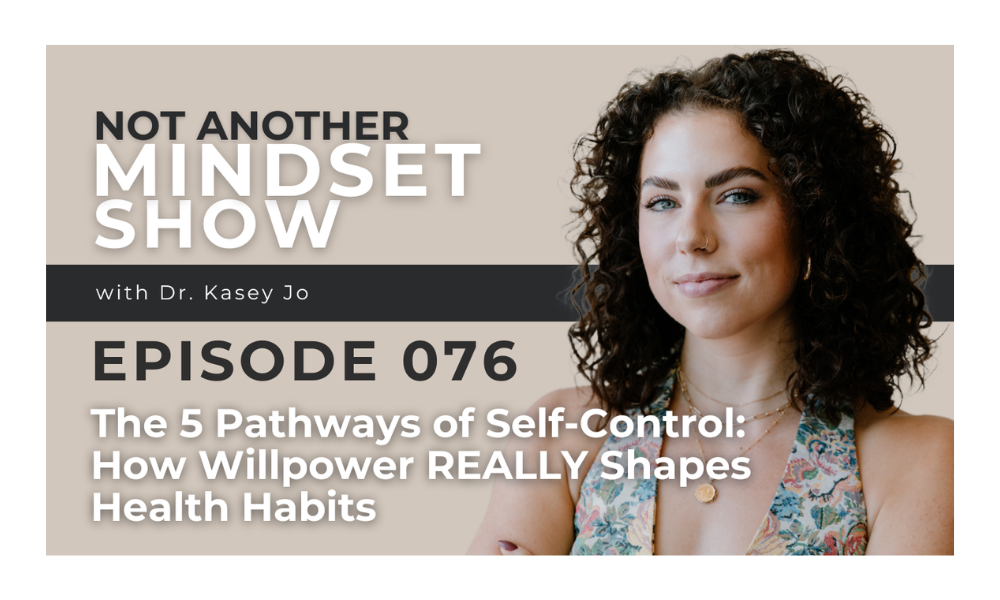
We talk a lot about self-control in the health and fitness world, but most people never learn how it actually works or how much it truly impacts long-term behavior change. In this episode, I’m breaking down research that identifies the five pathways of self-control that shape our health habits: valuation, prioritization, habituation, translation, and inhibition.
I walk you through each pathway, what it really means, and how these processes go far beyond “just have more willpower.” I also touch on practical ways you can apply these pathways in your coaching. When you understand how these pathways work together, you can help clients create routines that feel sustainable and not forced.
And if you want more support in helping clients follow through, stay consistent, and overcome all-or-nothing thinking, don’t forget to grab my 5 FREE lessons in behavior change and mindset.
Episode Highlights
>>(1:42) How self-control supports health behaviors.
>>(5:43) Pathway 1: Valuation
>>(8.29) Pathway 2: Prioritization
>>(12:30) Pathway 3: Habituation
>>(14:21) Pathway 4: Translation
>>(16:51) Pathway 5: Inhibition
Tune into the episode to discover how the five pathways of self-control can transform the way you coach long-term consistency.
Rate, review, and subscribe to my podcast.
If you enjoyed this episode, I’d be incredibly grateful if you could rate and review the show on your favorite platform. Your feedback helps me improve and allows others to discover the show. I want to hear from you whether you’re loving it, or have suggestions on making the show better!
Simply scroll down to the review section on Apple Podcasts, Spotify, or wherever you listen, and leave your thoughts. Your support means the world to me and helps me continue to bring you more of the content you enjoy.
Links From the Podcast
Goal Clarity Worksheet – FREE DOWNLOAD
Blog post: The Best Way to Set Goals: Ditching SMART Goals for More Effective Goal-Setting Strategies
Check out my other podcast episode on SMART(ER) Goals.
Want me to answer your questions on my next Q&A episode? Drop your questions here!
More podcast episodes from Not Another Mindset Show
Health Mindset Coaching Certification Instagram
Getting started with the Health Mindset Coaching Certification (5 FREE lessons included!)
Episode’s Full Transcription
It’s like, do they have a belief that no matter what they do, they can’t lose weight? Or that a belief that exercise is only for the purpose of body composition and uncovering these beliefs can be so helpful and helping them really start to recognize. What may not actually be true or not true for them, and in addition to figuring out what they value and what they really believe in and what they want for themselves, and doing a better job at attaching that to the behaviors themselves.
Hello my friends, and welcome back to Not another Mindset show. I’m your host, Dr. Kasey Jo. My goal with this podcast is to take the science of mindset and behavior change and distill it down into actionable takeaways for you together. We’re gonna. Unpack research around motivations, self-sabotage, willpower, and so much more, and we’re going to take all of that and translate it into strategies you can immediately apply to your health, fitness, relationships, business, marketing clients, all of the things.
But just to be clear, it’s not all serious and sciency around here. We’re gonna have a ton of fun too, and I’m so excited to share all of this with you. Alright, let’s go ahead and get into the episode. Hello my friends. Welcome back to Not another mindset show. Today we are talking about self-control, and I know I have talked about self-control and self-sabotaging behaviors, how to help and support your clients through those things.
Talked about that. A lot on the podcast. So if you’re interested in more, all you gotta do is scroll down through the episodes and you will very quickly find other episodes about this topic, at least similarly. But we’re doing it a little different today ’cause I’m going to be essentially breaking down a piece of a study that I recently found that I thought was so interesting.
And this study was essentially. Looking at how does self-control promote health behaviors? So we already know that self-control is important when it comes to health behavior change and sticking to the plan, saying no to that third margarita, et cetera. But how does this actually work? Because if we can better understand.
How self-control actually supports health behaviors and not just at face value. Thinking about how sure if you have impulse control or you know how to say no to things, like that’s going to help you be healthier in a lot of instances, but it kind of goes beyond that, and if we can better understand how this actually works and what that means for your coaching.
With clients who are struggling with self-control or willpower, it can be really, really empowering. So with this study, what they did, it was a longitudinal study, it was a survey-based study. They had 633 people go through it, and they completed different surveys on self-control, health behaviors like diet, physical activity, and smoking.
So the key findings of this study were essentially just the identification of five different pathways for. Essentially how self-control works. So we’re gonna walk through those different pathways, and these are like a, like I’m saying here, the pathways to self-control and like what that actually looks like.
So if we’re looking at how self-control. Impacts health behaviors. What these researchers essentially found were five different pathways, and they were also looking at these pathways with the idea in mind that we already have a lot of research on self-control. So they were taking what they know from the literature as it already exists and keeping that in mind through this survey data.
And when I say pathways, this is referring to. The specific mechanisms or routes through which self-control influences health behaviors. You can kind of think of pathways as like bridges that connect trait self-control to actual behavior change. So while we know self-control is important. How does it actually work?
And then how can that influence how we coach our clients? So with the context of this study specifically, the pathways are essentially illustrating the different processes by which self-control can lead to improved health behaviors. And each pathway really re. Distinct aspects of how self-control works in practice.
So you can hopefully understand at this point, I’ve said it like seven different ways that what we’re looking at here is not just the general relationship between self-control and health behaviors, but kind of teasing it apart and looking at what those actual route. Are. So when we identify and understand these pathways, we gain a more comprehensive view on how self-control actually works beyond just merely the.
Impulse control or get avoiding temptations. Right? And we see that self-control is actually pretty multifaceted. And when we can understand this, coaches, you can be so much more effective in your support with your clients because you can identify which pathway your clients are maybe going down if they are.
High in trait self-control, and you can see kind of what’s going on. Or better yet, when your clients are struggling with willpower and self-control, what pathways may need to be supported in order to enhance that self-control, if we wanna say it that way. There’s five different pathways that these researchers determined, and the first one is valuation.
This is essentially how self-control influences people’s ability to evaluate health behaviors. So we know that people who are higher and trait self-control, that actually influences their attitudes, norms, and overall just perceived behavioral control. So what I mean by that. We can look at cognitive attitudes.
So this is beliefs about the long-term benefits or outcomes of certain health behaviors. So people high in self-control tend to have a better handle on those long-term benefits. They also have more feelings of enjoyment or pleasure associated with health behaviors. They have perceptions about how health behaviors are, how common they are, like within their social group, or just social norms and.
Overall have a higher belief about one’s ability to perform health behaviors. They feel like they have more control. So what are the takeaways with this valuation pathway? What we want to be doing is not just helping our clients resist temptation, but according to this pathway, the valuation pathway. If we can help them uncover their belief systems and their values associated with.
Health behaviors and help them just like better attach them to the health behaviors, they’re going to be more likely to exert self-control in situations. And that’s what we see with people who already have higher quote unquote self-control. And we can see too where, or at least I can, and I’m gonna tell you about it, where growth and fixed mindset play a role as well.
Like thinking about what beliefs your clients currently have. And how that might be holding them back. So like thinking more on a fixed mindset side of things. Like do they have a belief that no matter what they do, they can’t lose weight? Or that a belief that exercise is only for the purpose of body composition and uncovering these beliefs can be so helpful and helping them really start to recognize.
What may not actually be true or not true for them, and in addition to figuring out what they value and what they really believe in and what they want for themselves, and doing a better job at attaching that to the behaviors themselves. So if we can create this supportive environment where if healthy behaviors are.
Are not just attached to our values and our beliefs, but also is very normalized and encouraged because we’re talking about within this pathway what we see as like the social norm of other people. All right. Pathway number two is PRI prioritization. Why did I struggle so hard. Prioritization.
Prioritization. What’s not a difficult word, Kasey? Um, so the prioritization pathway is about how people decide which factors are most important when they’re forming intention. To engage in health behaviors. So what the researchers are saying here is that people with higher self-control are better at focusing on rational long-term benefits to health behaviors and just generally the practical aspects of doing that health behavior, rather than the people who maybe aren’t so high in self-control, or at least say that they aren’t.
They believe that they aren’t. They are more likely to be swayed by immediate feelings or social pressures. So those with high self-control, essentially just give more weight to logical thoughts about the health benefits and their own ability to actually perform the behavior, which again, kind of ties back.
Um, no one should be surprised in bringing this back to mindset at like every single pathway. But if you believe you can’t do it, and you believe that. Something’s going to happen to you based on like your social group or your, you can’t manage your emotions in certain situations, then yeah, you’re gonna struggle with self-control during those times.
So you can also see where so far, pathway one and two. If we’re supporting our client’s mindset, then this would be really helpful. So. Essentially people with a higher self-control are asking themselves, how beneficial is this to my health? How realistically can I do this? Whereas maybe people who aren’t at that place yet, yet, ’cause you can get there and we can help our clients get there.
They aren’t necessarily having those thoughts. Exactly. So they’re not thinking as much about those long-term outcomes and prioritizing those things. And they’re overall just less influenced by what others think they should do or by habits, things that they’ve always done in the past. And they make decisions based more on their own values and goals.
So you can see we’re kind of like coming back. Pathway one being valuation, pathway two being prioritization. We’re still now taking, putting things in a higher priority based on our values, but values are still important here. So we. Want, what do we wanna do with our, our clients here, based on the prioritization pathway?
We wanna encourage rational decision making and reduce social pressures and influence. If we want to kind of like elevate this pathway, if we see, and I would really encourage you guys to be thinking like the clients that you might have that are struggling with willpower and self-control. Which pathway do you think is the one that, and there may be more than one, which is also fine, it might be all of them.
Which one do you need to really augment, do you need to pay attention to? So here. We can help clients focus on long-term benefits and practical aspects of health behaviors, discuss how regular exercise can lead to better health outcomes, what steps they can take to fit their routines. Kind of like that all sounds pretty basic, right?
But I think so often as coaches, we can just like kind of get into the groove of working with our clients and we forget that like, oh, how important it is to tie this back to values and priorities and all of that. And this is so much of what we talk about in the health mindset coaching certification as well.
In fact, as I said, that values and priorities, we have a values and priorities worksheet inside the health mindset coaching certification that we give to our students to use with their clients. So I actually love that. ’cause now I’m like, huh, look at that. We’re supporting one of the pathways of self-control with that worksheet.
Um, and also just thinking about how we can guide clients to make decision. Based on their own health goals, rather than just doing what others expect or what they think that they should do, and really encourage them to set personal goals that resonate with their own values. So in the goal setting process, are you having like a values and priorities conversation with your clients?
If you’re not, you’re not necessarily supporting this pathway. Alright, pathway number three, habitation. So self-control. AIDS in forming beneficial habits. It makes health behaviors more automatic and more effortful. And this kind of comes down to two separate things, automaticity and consistency. And we know with creating new habits, being consistent and putting in the reps over time, you’ll see things become easier and easier and less effortful.
So with self-control, people can establish routines that make healthy. Behaviors feel more automatic with time and once a behavior feels more automatic, it doesn’t require as much willpower. So you can see how habituation that’s this pathway and helping our clients develop things over time through consistency and getting their reps in can actually be really supportive to self-control.
So takeaways for you with your coaching and with your clients who might be struggling with this aspect is to come back to repetition and consistency. And I know that sounds kind of basic as well, but again, we can kind of get lost in the sauce when we’re, when we’re coaching and not come back to some of these basic things.
So how can we create. Stable context and cues for health behaviors to start to become more automatic and like what is triggering our clients to maybe do the unhealthy thing versus the healthy thing and like working with them on that so that over time again, it just becomes a little bit more automatic to do these things.
I mean, so many of you that are listening to this podcast are health and fitness coaches, and you’ve been doing the health and fitness journey yourself for so long. That you get this, you can totally see where your self-control, where you think it might be really good is actually just a healthy habit in disguise.
So the fourth pathway is translation. The translation pathway is about turning intentions into actions and explains how self-control can help people move from wanting to do something to actually doing it. So. Kind of couple aspects here, like stable intentions are really important ’cause people with high self-control can they form clear and consistent intentions.
They know what they’re out there trying to do and then they’re getting after it. They know what they wanna achieve and they’re committed to doing it. And implementation intentions. Ooh, don’t die. Love a good implementation intention. That may have been. The nerdiest thing I have ever said in my life. But Implementa implementation intention say that like 12 times fast.
They, it’s this idea that you’re making plans for when, where, and how you will carry out your intentions rather than just saying, I’m going to eat healthy today. Like, this is how I’m gonna do it. This is where I’m gonna do it, this is when I’m going to do it, which then can help bridge the gap between intention and actual action.
So. What can you do with clients who are like, oh yeah, I definitely feel like I have clients who are making all of these good intentions and they’re not actually following through on them, and that is hindering their self-control. That means they have, they have a problem with their fourth pathway, the translation pathway.
They can’t translate their intentions into actions. So goal setting, I kind of mentioned this already, but really comes into play here and I actually really think this is where I would wanna send you to the Smarter Goals Podcast, not Smart Goals. Smarter Goals podcast episode where I am breaking down essentially a goal setting framework for you, and it really does involve like getting specific on things, which is part of the original smart goal framework, but then also a lot of other things that have kind of changed and tweaked.
So definitely go listen to that. Um, oh, oh, oh oh. This could actually be really helpful too. I have a freebie for you. It is called the Goal Clarity Worksheet. I need to make sure that I include that in the show notes for you guys, because that’s also a way to kind of get to this point of translation. From intention to action is getting really clear and specific on those intentions, which means clarity and your goal setting.
So I’m gonna put that worksheet in the show notes. It’s totally free, like I said, but it’s an opportunity for you to literally take the worksheet, give it to your clients, and you guys can work on it together. All right, our fifth and final pathway is inhibition. This is all about resisting temptations and impulses.
I know I started the podcast saying it’s not just about resisting impulses and and temptations, but that is still a big part of self-control. So it is still one of five pathways that we are mentioning here, and just kind of shows how self-control helps people avoid behaviors that aren’t aligned with their health goals.
So there’re kind of two aspects to this as well. We’re looking at impulse control and we’re looking at overall just like moderating influence. And what I mean by moderating influence is that this pathway. Connecting self-control to health behaviors helps people manage the influence of strong emotions or habitual behaviors that might lead them astray.
So how can we help our clients who might be struggling with this aspect? The in inhibition pathway aspect, which I think so many of our clients are. I think a lot of people, especially in like the health and fitness coaching realm, they are falling prey. Here to this, to the lack of this pathway rather. Um, so we want to better support this pathway.
So how can we help clients develop strategies to resist temptations such as pausing before, making decisions, practicing mindfulness, using some form of maybe even distraction technique. Um, I don’t really love like having a full discussion on how do we just like resist temptation all the time. ’cause the goal should be almost to avoid.
Rather than to resist, like how do we just not put ourselves in a position to have to exert self-control in the first place rather than continuously putting ourselves in those positions and having to exert self-control? And this was something I have talked about on previous podcast episodes about self-control.
So if you wanted tune into those a little, learn a little bit more about that. But it does come back to also just helping clients become more aware of. Certain emotions or situations or people that trigger unhealthy behaviors so they can become aware of when they’re going into those scenarios. And that’s where you can use things like implementation intentions and so many other strategies within mindset and behavior change type of coaching to help them build on this pathway rather than it being like a weak point.
Which actually kind of like makes me think about all of the pathways that I just worked through with you guys. If. It could be almost used as an assessment. If you have clients who are struggling with self-control, or maybe even saying that they’re not good at self-control, is to even talk them through these five different pathways and have them, because we’re always trying to boost autonomy and put our clients in the driver’s seat, right?
Something I talk about all the time, have them maybe even say, oh yeah, this pathway is one that I struggle with. And like, but this one’s pretty strong, right? So. All of this to say there is a multifaceted nature to self-control and there is a need for tailored coaching strategies based on these different aspects of self-control, because not every client is going to be the same and struggling with self-control in the same way.
Or like even looking at your clients who maybe are really quote unquote good at self-control. Which pathways are being highlighted the most? Kind of just like do a little bit of research on your clients that are doing well in this regard. So what I really hope is that you can use this information to just equip yourself and equip your clients to really enhance self-control in a way.
But we’re doing so by kind of tackling some of these other big rocks like values and priorities and habits and social norms and all the other things that are at play because it really is not just cut and dry, self-control equals better health behaviors. There’s so much other stuff going on, and once we can better understand that, we can better help our clients with that.
Okay. I hope you enjoy this episode. This one was really fun for me to dive into because I, I found this study and was like, I could just talk about the whole study, but I really like this pathway conversation and I think it’s gonna be really helpful for coaches. So I hope it was, if it was, maybe, maybe just, maybe you could consider leaving a five star review.
And if it, if you wanna write something into that, you could just click the stars, just click the stars and give us five stars and don’t leave any type of note. You can absolutely do that. However, if you want to win. A free workshop from me. Then you need to screenshot your actual review, like the text of your review and put it into our review form, which we link in every single episode.
The show notes, it’s in there. You just have to upload it so you can put in your name and email, so when you win, we know how to contact you. Okay. Otherwise, that’s all I have for you. And I will see you next week. And that’s a wrap for today’s episode of Not Another Mindset show. If you enjoyed today’s episode, don’t forget to hit that subscribe button so you get notified of the next one.
Because if you’re anything like me, if the episodes aren’t popping up for you automatically. You’ll keep forgetting to come back to the show even if you really, really enjoyed it. So go ahead and hit that subscribe button and make it super easy for you. And of course, if you wanna see more episodes just like this one, I’d love for you to let me know by leaving a review.
I know, I know it’s super annoying to do, but the few seconds that it takes means the world to me and also ensures that I can keep providing free education and value to you and just to sweeten the deal. I am going to be picking a random reviewer every single month to receive a free workshop or product from me.
If you’re looking for more free resources or just wanna connect, hang out, chat a little bit, come find me on Instagram. I’m Coach Kasey, Jo over there. That is where I hang out the most in the land of social media. Alright, my friends, that is all I have for you this time. I so appreciate you being here and love to see you prioritizing your growth.
I’ll see you next time.