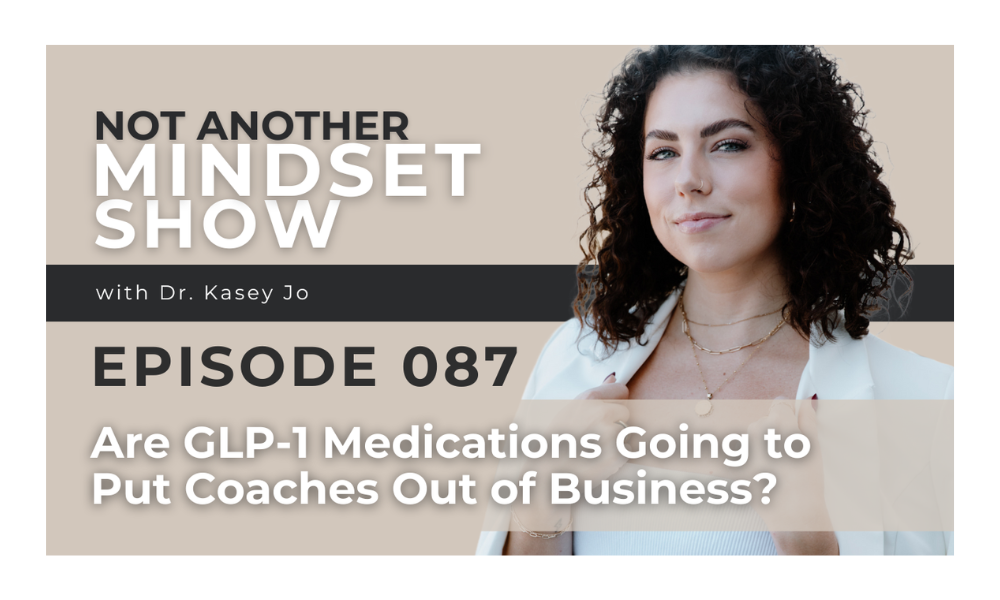
Rethinking the role of coaches in a world where weight loss medications are more common.
Are you worried that GLP-1 medications like Ozempic, Wegovy, or Mounjaro are going to make health and fitness coaches obsolete? In this episode, I break down why these medications are changing the weight loss conversation but not replacing the work coaches do. In fact, they’re making coaches more essential than ever (so long as you have the tools to help your clients outside of the typical nutrition and fitness methods).
I walk through what GLP-1 medications actually do (and what they don’t), why an estimated 50–75% of users stop taking them within a year, and why medication alone doesn’t teach skills around mindset, identity, or long-term habit formation. Weight loss may happen faster, but without behavior change support, the foundation often isn’t there.
I also talk about how coaches can ethically and professionally support clients who are using GLP-1s. From navigating transformation posts and disclosure, to preserving muscle, managing shame, and supporting identity shifts. And if you want to deepen your ability to coach behavior change beyond the scale, be sure to grab my 5 FREE lessons in behavior change and mindset. These lessons will help you coach clients through fixed thinking, build sustainable habits, and support long-term follow-through.
Episode Highlights
>>(1:26) Understanding GLP-1 medications
>>(2:12) What GLP-1 medications mean for the coaching space
>>(5:28) The importance of behavior change
>>(7:23) Marketing and supporting clients on GLP-1
>>(14:01) Ethical dilemmas in coaching
>>(14:52) The Coaching Code
>>(15:44) Real-World coaching challenges
>>(23:46) Strategies for effective coaching
Tune into the episode to understand how GLP-1 medications are reshaping coaching and why mindset skills matter more than ever.
Rate, review, and subscribe to my podcast.
If you enjoyed this episode, I’d be incredibly grateful if you could rate and review the show on your favorite platform. Your feedback helps me improve and allows others to discover the show. I want to hear from you whether you’re loving the insights or have suggestions on how I can make the show even better!
Simply scroll down to the review section on Apple Podcasts, Spotify, or wherever you listen, and leave your thoughts. Your support means the world to me and helps me continue to bring you more of the content you enjoy.
Links From the Podcast
Want me to answer your questions on my next Q&A episode? Drop your questions here!
More podcast episodes from Not Another Mindset Show
Health Mindset Coaching Certification Instagram
Getting started with the Health Mindset Coaching Certification (5 FREE lessons included!)
Register for my FREE 3-Day Training: The Coaching Code
Episode’s Full Transcript
Please keep in mind, please, please keep in mind that people hire coaches for bigger reasons than weight loss. We are so weight loss centric in the health and fitness industry, and to be honest, my friend, you do have a responsibility to adjust that narrative. Like, just think for a second. If all the coaches everywhere who are posting content on Instagram, if they started talking about other aspects of health and fitness outside of just losing weight and getting smaller, what would that mean?
Hello my friends, and welcome back to not another Mindset show. I’m your host, Dr. Kasey Jo. My goal with this podcast is to take the science of mindset and behavior change and distill it down into actionable takeaways for you. Together we’re gonna unpack research around motivations, self-sabotage, willpower, and so much more, and we’re going to take all of that and translate it into strategies you can immediately apply to your health, fitness, relationships business.
Marketing clients, all of the things. But just to be clear, it’s not all serious and sciency around here. We’re gonna have a ton of fun too, and I’m so excited to share all of this with you. Alright, let’s go ahead and get into the episode. Hello my friends and welcome back to not another mindset show. We got a hot topic on deck today and that is GLP one.
Understanding GLP-1 Medications
Medications. I will start by saying that I am not an md. I am a doctor, but not that kind of doctor. I’m not a pharmacist. I don’t have all the information in the world about GLP ones. I would like to do a little bit of education on what they are. I think there’s a lot of people out there who hear about GLP ones or know them by like Ozempic, wegovy.
I’m not probably even pronouncing that correctly to be honest, and just. Hear it as like a weight loss medication. People know you have to like inject yourself. Right? But how much more do we know beyond that? I’m gonna share a little bit, very little bit about. What GLP ones actually are and what the mechanism of action is, like, what’s actually going on with them.
What GLP-1 medications mean for the coaching space
And I mostly really wanna talk about what these medications mean for the coaching space. I work with so many coaches every single week, whether it’s in a business capacity, in my mentorship programs, or. Mainly I’m working with coaches on coaching practices and how to best support clients and help them stop, stop soft sabotage, stick to the plan, all of that good stuff from a mindset, behavior change and psychology perspective.
And right now with these weight loss medications being all over, all over, I cannot scroll on Instagram for three seconds without being hit with something related to GLP ones. So. I will say, the reason I finally said, you know what I need to sit down and do a podcast about this is because the coaches that I work with, there’s been a lot of conversation about how to support clients who are on these medications, clients who are interested in getting on these medications, what this means for the coaching space.
And so that’s kind of what I wanna get in today. Um, I think. Generally coaches deserve clarity and not like panic, like your job is your job at risk because people don’t care about coaching anymore ’cause they can just get on these medications. And also I think clients deserve support and not shame when it comes to wanting to use these medications, being curious or using them.
So that’s kind of the. That’s kind of like the belief system that I hold and where I want to go with this podcast episode. So let’s start with some basic definition, basic understanding. GLP one, medications. You’ve heard them as Ozempic or Wegovy or Manjaro. There’s a lot of other ones out there. They.
Mimic a hormone in the body that is already naturally produced and that hormone is glucagon. That’s where the G and GLP one comes from. It’s glucagon like peptide, and what it does is slows gastric emptying meaning. Your satiety goes up when you’re on these medications, you feel, feel full faster and reduces overall hunger and cravings.
You’ve probably heard them talked about reducing food noise, so just like less interest in food, less thinking about food. Also influences insulin response and blood sugar regulation. So. There’s 110% of time and a place for these medications. I’m not gonna get on here and be like, they’re the worst. No one should do it.
Nobody should be doing this. They’re a cheat code. You should just do it the old fashioned, the right way. That’s not what I’m here to talk about. Um, but it is important to understand that they’re not magic, right? They help people eat less easily, more easily, I should say. But they do not help with a lot of things that I talk about, right?
The importance of behavior change
Um, behavior change, stress management mindset, habits, identity coping tools. Communication skills for navigating emotions around food or speaking to other people in your life about your health and fitness goals. And that’s exactly where coaches are still important. And I will die on the hill of it.
Doesn’t matter what medication, what diet, what whatever is floating around the health and fitness industry. That working one-on-one with someone who can help coach you from a place. Of mindset and behavior change in psychology. Obviously I’m incredibly biased in this area. Having someone to help you with all of that is always going to be important.
So just like, it’s really just like the conversation we’ve been having forever about any other, not that this is like a diet, but like conversations we have about fad diets or short term fixes, things like that. What happens once the diet is over? We talk about this all the time, and this is an issue that people have had forever where they can lose the weight, but then they struggle keeping it off, right?
And a significant percentage of people who are using GLP ones, an estimated 50 to 75% of them will stop taking the medication within a year, 50 to 75%. So what happens after. We stopped taking the medication, and again, I think this is where coaches can be really, really helpful and supportive, whether it’s while their clients are on this medication.
Marketing and Supporting Clients on GLP-1
Setting them up for success once they come off the medication, supporting them once they’re already off the medication, working with them, before they’re on the medication, during and after. Like, I think there’s a lot of places where coaches can still be incredibly helpful and I, if you’re a coach listening to this, which chances are you are, or at least um, you’re a health and fitness professional in, in some capacity, I would really be thinking about that, especially just with how much is out there.
Talked about GLP ones. Is there a way in your marketing and in your conversations with prospective clients and in your content on Instagram where you can bring this conversation into light and talk about it from that perspective of what happens after? Is this something you wanna be on forever? Are you set up for success so that when you come off the medication, that you maintain the weight loss that you are seeking?
And although weight does come off faster, well, on this medication, the long-term outcomes still heavily, heavily depend on environment, habits, mindset, lifestyle patterns, identity level beliefs, emotional regulation. All of this is like behavior change and psychology one-on-one from a coaching perspective and.
The medications will not replace the need for that work. So the question becomes, are people still gonna wanna hire coaches? Because there’s, there’s fear out there. I have heard if clients can just take a medication, is it get going? To get to the point where they don’t feel like they need me? What’s the value of coaching when weight loss can be pharmaceutically, accelerated, or.
Will the fitness industry tank, is this going to change everything forever and people aren’t gonna wanna hire personal trainers and coaches and all of this stuff? Um, please keep in mind, please, please keep in mind that people hire coaches for bigger reasons than weight loss. We are so weight loss centric in the health and fitness industry.
And to be honest, my friend, you do have a responsibility to. Adjust that narrative like, just think for a second. If all the coaches everywhere who are posting content on Instagram, if they started talking about other aspects of health and fitness outside of just losing weight and getting smaller, what would that mean for the world?
People struggle with consistency and identity, conflict stress, eating all or nothing thinking perfectionism, motivation, self-efficacy. Emotional triggers, lack of supportive environments. I mean, the list goes on and on, and these are all mindset and behavior change issues and GLP ones are not going to solve any of those things.
Coaches will. That’s where coaches come in that is assuming you are not the type of coach who is basically just a glorified macro calculator. If your coaching is really just about. Assigning macros and providing a workout program. I’m just gonna say you should probably be doing more at this point. I mean, we’re, we’re already there where people are seeking more and then you throw AI into the conversation.
You throw GLP ones into the conversation. You really gotta do more in order to stand out. And if you’re really worried about your job being lost. The best thing you can do is just become a more effective, better coach. I mean, in general, my argument has always been for as long as I’ve, I’ve been doing this work for so long prior to any of the GLP one or AI conversations, is that coaches should be doing better anyway.
We shouldn’t just be telling clients what to do and checking in with them once a week and saying Good job and adjusting their macros. There’s so much more. We should be doing, period, end of story. Um, but without behavior change support, many people who are on these medications will regain the weight that they lost.
So coaching really can be seen as a treatment extender in a way, and I would love for you to start thinking about it and seeing it that way. And just generally how GLP ones can get you started. But with coaching and behavior change and mindset and all of these other skills and things that I talk about on this podcast all the time, those are the long-term anchors.
So, sure, let’s speed up this process, but also let’s make sure that it sticks. This is something you should be talking about in your content if you do speak to GLP one, usage with prospective clients, with your current clients who are interested or are on these medications. So to do a little bit of reframing for you as a coach, GLP ones really do remove the biggest barrier for people, and that is appetite.
Right desire to eat and wanting to eat hyper palatable foods and snacking and all of these things. So with that said, if you have clients who are on GLP ones. Your coaching actually becomes more effective, assuming you know how to leverage it in this way, because clients should have more mental bandwidth because they don’t have to worry all day long about what they can’t eat, what they can’t eat, and food noise and their hunger when they’re in a caloric deficit and all of these things.
So therefore, adherence should be easier, right? And results should come faster. For your clients, which then builds more momentum and excitement for seeing progress quickly. So you should help your clients use the medication well instead of just using it blindly. And could that be part of your conversations that you’re having with clients?
Ethical dilemmas in coaching
Again, in your content, in your messaging about how you should not be using it wi blindly, you should be leveraging it, knowing that it’s going to provide all of these. Positive effects for you. So the dilemma that many coaches are facing really comes down to a a handful of things. I wanted to bring up this very.
I was gonna say very specific example, but maybe it’s not specific because maybe it’s something that you’re struggling with, other coaches are struggling with. But this is a recent, I literally screenshotted this from our Facebook group for the HMCC Health Mindset Coaching certification. That is my bread and butter program.
For those of you who are unaware, um. This is from an alumni member, so someone who’s graduated from HMCC, and it sparked a whole conversation on our group calls and in the comment section, and I wanted to read it ’cause this is also part of the reason why I wanted to record this podcast. Okay. Really quick, I need to take a mid episode pause to tell you about something really exciting that’s coming up.
The Coaching Code
I’m hosting a free three day training series called The Coaching Code, and I really, really want you to be there. Thousands and thousands and thousands of coaches have enrolled in this free training in the past, and this time we’re making it better. Than ever, and I’m not just saying that we’ve got brand new mindset and behavior change coaching content for you around some specific hot topics like GLP ones and AI inside the coaching code.
I’ll be diving into strategies and tips that you need in order to help your clients stop self-sabotaging. Stick to the plan and ultimately stick with you longer. If you enjoy my podcast, you’re going to absolutely love the coaching code. We get started on February 26th. So head to the show notes right now to grab the registration link and snag your free seat.
Real-World coaching challenges
Okay, so here’s what he said. One of the coaches in our group started with celebrating clients who used GLP ones but aren’t open about it. This is a discussion I would love to hear other coaches weigh in on. I have a client who’s lost over 80 pounds over the last eight months. Whoa. And transformed his physique.
He’s not only lost weight, but built a ton of muscle. He started taking GLP ones a month before he hired me because he wanted to keep it off and change his lifestyle. So in this case. Client started taking the medication and then still hired a coach because he wanted to keep it off and change his lifestyle.
Note that important, he gets comments like, when I first saw you, I thought you had taken Ozempic, but now that I see your muscle, I can tell you, tell that you did it the legit way. Such a problematic compliment in and of itself. But alas, moving on. Um, my predicament is this. I have not highlighted his transformation on social media because he is not open about his GLP one usage.
He hasn’t said anything about this directly, but he’s made it made side comments about how much better he looks and how it’s all thanks to me and how he wants to support my business. Truthfully, I think he would love the external validation of an Instagram post. My concern is. That if I tell him I can’t post you without discussing, discussing your GLP one usage, he will feel hurt and that I’m downplaying the work he has done.
Obviously, I’m not, but also this weight loss has been insane and I’m not going to falsely advertise it as I’m such a good coach. I wish I could use him as an example for combining GLP ones with successful lifestyle shifts, weightlifting and nutrition coaching. What would you do in my situation? How are you handling clients are using GLP ones aren’t open.
Do you celebrate them the same? How do you make sure other clients don’t feel like they aren’t doing enough because they aren’t seeing results like him? Okay, that is the post. So to recap, that was a little long, so thanks for hanging with me. This client lost 80 pounds. And built muscle. Huge transformation.
This person definitely looks like an entirely new human right, but the client is not public about the GLP one use, and this coach wants to celebrate him, but with integrity, so does posting the transformation without context, mislead others does. Sharing it with context of the medication use violate the client’s privacy.
This client wants to support the coach. But hasn’t disclosed the medication publicly. So why this matters, like more clients are using GLP ones privately and not necessarily wanting to talk about it and kind of keep it to themselves, which is like just a really interesting thing to think about and conversation to be having with clients because why is, where’s the shame coming from?
You’re on this medication and you don’t wanna share about it, is it because you don’t want people to think that this whole conversation of like, think that you’re, you’re cheating, you’re taking the easy way out. Um, yeah, there’s definitely a lot of shame around it, which is where, again, coaching is just so important and how you coach is so important.
Um. I mean, yeah, coaches are unsure of how to ethically navigate this. Their social media pressure, comparison, compliment, complicates everything. Rather, obviously this is like where. Coach to client communication skills are already so important. And with something like this, we just like upped the ante by 700 levels, right?
Um, we spend so much time inside the health mindset coaching certification, talking about communication strategies, and now it’s been really powerful and really impactful for our coaches to bring in like real world situations like this, like I just read, and then refer back to strategies that we learned in the certification to support them.
So I do wanna share. Before I even got to this post in the Facebook, and this is why I love, love, love, love our students and the coaches who have graduated the program ’cause they all jump in to help each other. So one of the other students actually shared her response and I agreed with pretty much every line of it.
And I did wanna read that to you guys ’cause I think it also showcases just like how good our coaches are after going through this program. So I just, I feel like a proud mom all of the time. So she said posting dramatic transformations without context does create unrealistic expectations and can make other clients feel inadequate.
True. The fitness industry has enough pseudoscience and false promises already. Yeah. Makes this a sticky situation, right? Having said that, the conversation itself won’t hurt him tiptoeing around it or posting him without context. Those are the things that could cause harm to him, your clients, or your own integrity.
You could frame it collaboratively, something like, I’d love to feature you in a transformation because the work you’ve put in is incredible to tell your story authentically. I think we should mention DLP ones as part of your comprehensive approach. How do you feel about that? Love it. Gold stars, no notes.
Then listen. He might surprise you. And honestly, the message, let’s figure out how to celebrate you authentically is so different from avoiding the conversation entirely and potentially making him feel like his results are somehow problematic. Yes, yes, yes. A hundred times, yes. So really love this. And then.
I wanted to break it down because again, like this is a student who went through HMCC and has behavior change mindset, psychology tools, and everything that she’s talking about here of like presenting it, how to present it to the client and get their feedback and how they feel about the situation and wanting to stay.
Operating in integrity as the coach and just generally create a collaborative environment and a safe environment with this client. Um, but I think this is something that we’re going to continue to have to navigate. And I just, number one, want you to know that you’re not alone if this is something that you are dealing with, um, I do really recommend getting into some sort of supportive environment with other coaches who are going through this and not just other coaches who are going through this and.
Honestly just like bitching about it. Like, what am I supposed to do? I wanna share this transformation, but blah, blah, blah, and all of this stuff. Um, but instead, collaborative environments like we have, I’m not saying that you have to be a health mindset certified coach, that I am saying we got a pretty awesome community and if you’re looking for support, this is the place you wanna be.
Um, so yeah, wanted to share all of that and just like how it presents. A lot of dilemmas that you may not even think about. Those of you who have experienced them. Obviously you’re thinking about it, but yeah, there’s a lot of just, it’s like murky waters for sure, and it becomes how do we best navigate this as coaches and still support and like huge props to this coach for sharing this and being vulnerable and seeking support and understanding too, like what I loved about hearing.
All of this too is like this client lost a ton of weight. Yes, the medication helped with that, but also this client is coming back and saying like, your coaching is the reason that I really do look this way. You know, whether it was like the muscle gain and the lifestyle modifications and the mindset support.
Strategies for effective coaching
So even though the medication really supported this 80 pound weight loss, this client is saying, no, your coaching is. The bigger reason, which is really cool and is a huge testament to this coach’s skillset. Again, proud mom over here. So how can coaches support clients on GLP ones? Um, this coach example that I just shared is, does share examples of how exactly to do that, like focusing on strength training and muscle preservation.
It’s. Especially when on these medications because when clients are losing weight fast, I mean, this is nutrition coaching one-on-one, my friends. Um, there is a potential for muscle loss, so making sure that like high protein is in the picture and we are strength training, um, coaches play a major role in preserving the lean mass, right?
Teach habit formation and behavior change. Clients can’t rely on the meds alone. Forever. I mean, you can try, but helping them build routines and systems and adjusting their environment. Otherwise, it’s kind of like, honestly, I talked about this, I think like episode two of the podcast about how people going, leaving jail, you guys are probably listening like what?
Where’s this going? People leaving jail and going back into their environment. Like even if there are program programs while they’re in jail to help them. Go back into their environments and do things more productively and not commit crimes again to get back into jail. It’s so hard. It’s so hard because you’re removing them from their environment, putting them in a, in a new one, jail prison.
And yes, educating them and supporting them and giving them all of this stuff, but as soon as you put them back in that previous environment where. Crime was the issue in the first place. They’re around the same people. The chances of recidivism are really high, really high. I mean, it’s a big issue. Um, same thing here.
It’s, it’s basically the same. It’s like a parallel example here that. When we remove the medication, you just go back and your environment is the same. The people you’re around is the same, everything’s the same. Like of course you’re going to gain the weight back. So that’s where we come in as coaches.
And also just supporting our clients with their mindset around this, um, knowing that there’s shame involved, um, feeling like they cheated or they fear weight regain. They have. Could have like identity confusion or compare themselves to others. They might get like external validation that feels uncomfortable.
Kind of in the example that I shared from this coach where like, oh, you did it the legit way. I can tell because you’ve built muscle too. And he’s like, mm. I, I mean, yeah, I put a lot of work in and I’m working with a coach, but I was also using this medication. And does that now make it feel like it’s not the legit way?
I mean, it’s just so messy and. You as the coach can help them navigate that in such important work, assuming you have the skillset in order to do that. Um, also just helping them build. Things like self-efficacy, which we know from decades of research is so important when it comes to behavior change. Like when I say self-efficacy, I mean the ability to continue to see progress and stick to behaviors even in the face of obstacles and setbacks and challenges.
So what if the medication stops working? What if they stop taking it? We talked about this a lot. Um. So much motivational interviewing and cognitive behavioral coaching skills that come into play here. And also kind of coming back again, that many clients don’t want people to know that they’re on GLP ones.
So coaches, you need to have empathy, non-judgment, a safe space, support their autonomy. This is all like behavior change mindset. Coded communication, training in action. So all said and done, GLP ones are here to stay, but so is coaching, so coaching is going to shift, if not, is already shifting to less of with the GLP one conversation specifically.
Right. Not everybody is on a GLP one. Okay, so I’m not saying that either that like at some point every single person you work with is going to be on a GLP one. I don’t think that that’s going to be the case, but it’s going to be less about like willpower coaching and how do we like make sure that you can stave off your hunger and eat voluminous foods and all these things with these clients who are on these medications.
And it’s going to be more about the psychology and the communication and. Identity work, behavior change, modeling, and supporting them before, during, and after these medications. So if you’re a coach who only knows macros and you only know how to write a training program. You will probably be a coach that does struggle during this time because it’s the coaches who understand mindset, communication, self-efficacy, habits, identity, emotions, all of the stuff I’ve been talking about here.
All of the stuff that I talk about on the podcast all the time, you’re gonna thrive because people still need you. And it is up to you though to make that clear, because I think there’s always going to be the issue that people out there, your prospective clients who are on these medications don’t. Maybe see the necessity of a coach.
So it’s also up to you and your responsibility to showcase that necessity. I’m kind of talking from like a marketing and sales perspective here. Um, GLP ones aren’t going to support your client’s psychology. You are. So how do we make that clear and how do we make sure we are capable of doing that as coaches?
Okay.
I think. Yeah, that’s mostly what I have to say. I think GLP ones don’t replace coaches. They replace the illusion that weight loss alone is the goal. Now, more than ever, clients need support with the human side of change and maintaining that change, and this is why behavior change, education and training.
So, so necessary. I mean, it’s always been necessary, but it’s even extra necessary now. Okay. I am done with this episode. Nice closing, Kasey. Um, I appreciate you listening. I. S open up my DM doors, my email doors to continue this conversation. If anything else is coming up for you, if there’s something else you would like me to speak on regarding this, this is like, it’s a big topic and to be honest, I kind of feel like throughout that episode I had a hard time ’cause it’s like I could go really deep into so many of these different areas, whether it’s the shame that your clients are experiencing from things or.
How to navigate it as the coach and how to talk about client transformations when this is involved. And again, like supporting that maintenance after. What does that look like? I mean, there’s so many directions I could go. Um. But I also don’t wanna sit in front of this camera and in front of this microphone for the next five hours.
Um, yeah, but let me know ’cause I’d be happy to dive into more of these topics and future episodes if that is something that you’re looking for. Um, yeah, I appreciate you being here. As always, thank you for listening, and I’ll see you next time. And that’s a wrap for today’s episode of Not Another Mindset show.
If you enjoyed today’s episode, don’t forget to hit that subscribe button so you get notified of the next one, because if you’re anything like me, if the episodes aren’t popping up for you automatically, you’ll keep forgetting to come back to the show even if you really, really enjoyed it. So go ahead and hit that subscribe button and make it super easy for you.
And of course. If you wanna see more episodes just like this one, I’d love for you to let me know by leaving a review. I know, I know it’s super annoying to do, but the few seconds that it takes means the world to me and also ensures that I can keep providing free education and value to you. And just to sweeten the deal, I am going to be picking a random reviewer every single month to receive a free workshop or product from me if you’re looking for more free resources.
Or just wanna connect, hang out, chat a little bit. Come find me on Instagram. I’m Coach Kasey, Jo over there. That is where I hang out the most in the land of social media. Alright, my friends, that is all I have for you this time. I so appreciate you being here and love to see you.