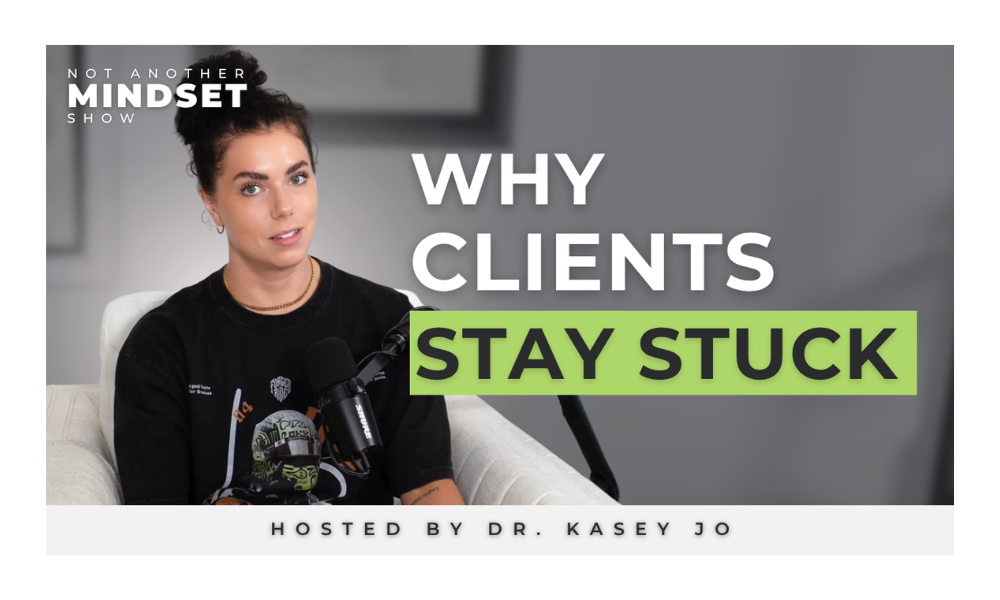
Why don’t my clients follow through, even when they clearly want to change? Your clients don’t have an intention problem. Research suggests most people who fail to follow through on health goals genuinely intend to do them. They want to go to the gym. They want to meal prep and take better care of themselves. The real issue is the intention-behavior gap: the space between deciding to do something and actually doing it.
In this episode of Not Another Mindset Show, I’m breaking down the intention-behavior gap. I’ll cover why the theory of planned behavior isn’t enough on its own to explain client follow-through, and what actually closes the gap between a client intending to change and actually changing. I’ll also connect it to how I built the curriculum inside The Health Mindset Coaching Certification, since this whole topic came from a student’s question about my own program design decisions.
If you’ve ever had a client tell you “I know what I’m supposed to do, I just don’t do it,” this is the science behind that sentence.
What You’ll Learn in This Episode
- What the intention-behavior gap actually is, and why it explains most follow-through problems
- The three components of the theory of planned behavior, and why the theory itself is contested in the research
- Why a big shift in intention often only produces a small shift in actual behavior
- What actually helps close the gap between intending to do something and doing it
- How to respond the next time a client says “I know what to do, I just don’t do it”
Why Don’t My Clients Follow Through, Even When They Know What To Do?
Most of the time, it’s not a knowledge problem. It’s not a motivation problem either. It’s a gap between the intention to act and the action itself. Your client can want to go to the gym, believe it’s good for them, and still not go. Behavior change research documents this gap well, and it even has a name: the intention-behavior gap.
This matters because most coaches default to a specific assumption. They assume a client who isn’t following through must not want it badly enough, or needs more information, or needs more motivation. But your client likely already intends to do the thing. Piling on more reasons why they should do it usually misses the actual problem. The problem isn’t the intention. It’s everything standing between the intention and the behavior.
Does the Theory of Planned Behavior Explain Why Clients Don’t Follow Through?
Most coaches (and a lot of nutrition certifications) lean on one specific model to explain why clients don’t follow through: the theory of planned behavior. This theory names three components that shape intentions, and therefore behavior. Attitudes come first: how positively or negatively someone views the behavior. Subjective norms come second: the social pressure around doing it. Perceived behavioral control comes third: how easy or hard someone believes the behavior will be, which overlaps heavily with self-efficacy.
It’s not a bad theory. Those three components genuinely matter. But here’s why it’s not the backbone of how I teach behavior change inside HMCC: even a well-formed intention, built from all three components, doesn’t reliably predict behavior. Research documents this well. It’s not a hunch.
Why This Theory Isn’t Taught in HMCC (And What It Means for Why Clients Don’t Follow Through)
This question came from one of my own students. She submitted it through the show’s Q&A form (more of you should use that, by the way, I almost always pick from it). She’d learned the theory of planned behavior in a different nutrition certification and asked why HMCC doesn’t teach it directly.
Here’s the honest answer: the theory isn’t wrong or useless. But the research around it is genuinely contested. Its strongest findings also hold up better for short-term behavior change than for the long-term, sustained change coaching actually tries to create. A 2014 paper by Sniehotta, Presseau, and Araújo-Soares argued the model has reached its limits. They bluntly titled it “Time to Retire the Theory of Planned Behaviour.” Icek Ajzen, the psychologist who originally developed the theory, published a direct rebuttal defending it. Both sides make fair points.
I didn’t want to build a certification around a theory with that much active academic debate attached. Instead, HMCC teaches the pieces that hold up (like perceived behavioral control, which is essentially self-efficacy) through frameworks with less contested ground underneath them.
The Science: Why Intention Alone Doesn’t Predict Whether Clients Follow Through
A well-known meta-analysis by Webb and Sheeran (2006) found something important. Even a medium-to-large shift in someone’s intention tends to produce only a small-to-medium shift in their actual behavior. In plain terms: you can significantly increase how much someone wants to do something. You’ll still often see only a modest change in whether they actually do it.
This is exactly why intention alone can’t drive how coaches predict or explain client follow-through. It also explains why perceived behavioral control tends to be the theory’s strongest, most durable component (it’s essentially the self-efficacy piece). Self-efficacy is the belief that you can keep doing something even when it’s hard. Coaches can build that belief directly. That’s a much better bet than hoping a client’s overall intention grows strong enough to override everything working against it.
What Actually Helps Clients Follow Through? Closing the Intention-Behavior Gap
Closing the gap requires specific tools, not more reasons why the client should follow through. Two things make the biggest difference:
- If-then planning (implementation intentions). Research from Gollwitzer (1999) supports this tool directly. Specific “if this, then that” plans significantly improve follow-through compared to a general intention alone. An example: “If it’s Monday, Wednesday, or Friday at 6am, then I will put on my workout clothes before I check my phone.” You don’t write this plan for your client. You coach them to write it themselves.
- Diagnosing the specific broken link, not the general lack of willpower. Inside HMCC, we call this the follow-through chain. It has several connected links: a client’s why, their belief they can actually do it, how they handle a hard day, what triggers a slip, how they process the feelings that come with falling off track, and how flexible they can be about getting back on. When a client isn’t following through, don’t assume the whole chain failed. Find the specific link that broke instead.
How to Respond When a Client Says “I Know What to Do, I Just Don’t Do It” And Help Them Follow Through
Many coaches respond to that sentence with more education, more conviction-building, or a new plan. Research suggests none of that closes an intention-behavior gap. The client was never missing the intention in the first place.
Try this instead: “It sounds like you already know this matters to you, so let’s not spend more time on why. Let’s figure out what’s actually getting in the way when it’s time to do it.” From there, get curious about the barrier itself. What makes this specific action hard to start? What makes it hard to sustain, right now, for this specific person? Don’t assume laziness, low motivation, or a lack of willpower.
This is exactly the kind of skill we go deep on inside The Health Mindset Coaching Certification. Knowing the intention-behavior gap exists in theory is one thing. Actually diagnosing why your clients don’t follow through, in a live client conversation, is a very different skill.
Key Takeaways
- Why don’t my clients follow through? Research suggests it’s rarely an intention problem. Most people who don’t follow through still genuinely want to.
- The intention-behavior gap describes the well-documented space between intending to act and actually acting on it.
- The theory of planned behavior explains some of why intentions form, but findings suggest it’s a stronger predictor of short-term behavior than long-term, sustained change. It also remains an academically contested model.
- If-then planning (implementation intentions) is one of the more well-supported tools for closing the gap between intention and action.
- When a client says “I know what to do, I just don’t do it,” diagnose the specific barrier. Don’t add more reasons why they should do it.
Frequently Asked Questions About Why Clients Don’t Follow Through
Why don’t my clients follow through even when they know exactly what to do?
This is almost always the intention-behavior gap at work. It’s the well-documented space between intending to do something and actually doing it. Research suggests intention alone is a weak predictor of behavior, so a client can genuinely want to follow through and still struggle. The fix isn’t more motivation or education. It’s identifying the specific barrier sitting between their intention and the action.
What is the intention-behavior gap?
The intention-behavior gap is the difference between forming an intention to do something and actually carrying it out. A meta-analysis by Webb and Sheeran (2006) found that even a medium-to-large increase in someone’s intention typically produces only a small-to-medium increase in their actual behavior. That’s why intention alone can’t predict follow-through on its own.
What is the theory of planned behavior, and is it still used in coaching?
The theory of planned behavior says attitudes, social norms, and perceived behavioral control shape intentions, which then predict behavior. It’s a real and useful framework, but it’s also contested. A 2014 paper argued it should be retired. Its own creator, Icek Ajzen, published a rebuttal. Many coaches still use pieces of it, like perceived behavioral control, without teaching the full model.
What is if-then planning and does it actually work for client follow-through?
If-then planning, also called implementation intentions, means coaching a client to write a specific plan: “if this situation happens, then I will do this behavior.” Research from Gollwitzer (1999) found this tool significantly improves follow-through compared to a general intention alone. It likely works because it removes in-the-moment decision-making.
What should I say to a client who tells me “I know what to do, I just don’t do it”?
That sentence describes the intention-behavior gap in real time. Avoid jumping to more education or convincing them why they should do it. They already know, and they already want to. Instead, ask questions that help you both identify the specific barrier. What makes this behavior hard to start, sustain, or return to after a setback?
Is lack of motivation the same thing as the intention-behavior gap?
Not quite. Motivation and intention are closely related, but the intention-behavior gap specifically describes why intention doesn’t reliably translate into action, even strong intention. A client can be highly motivated and intentional and still fall into this gap. That’s why coaching needs tools beyond building more motivation.
Links & Resources
The ABCs of Behavior Change | EP 20 — more on self-determination theory, one of the frameworks HMCC teaches instead of the theory of planned behavior.
Ask Me Anything: Clients Who Make Excuses | EP 54 — a related look at what’s really going on when a client seems to be “making excuses.”
Identifying a Fixed Mindset In Clients (And Coaches) | EP 53 — useful alongside this episode when a client’s self-efficacy (perceived behavioral control) seems to be the real blocker.
Health Mindset Coaching Certification
Follow Dr. Kasey Jo on Instagram: @drkaseyjo
AUTHOR BIO
Dr. Kasey Jo Orvidas, PhD is a published mindset and health behavior change researcher with over a decade of health and fitness coaching experience. She is the founder of the mindset and behavior change coaching program: The Health Mindset Coaching Certification.