
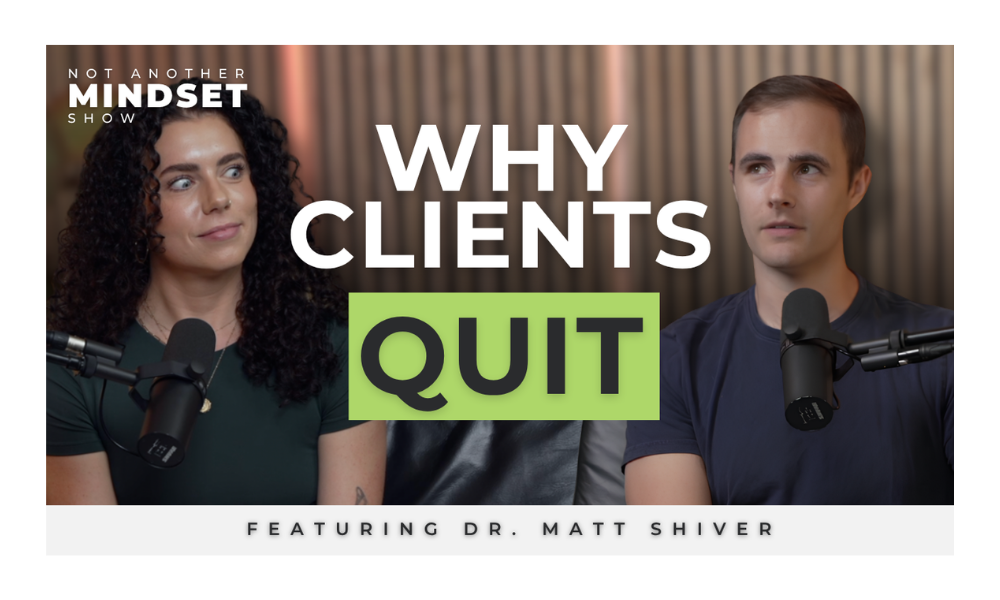
Growth mindset for your coaching business isn’t optional if you want it to survive a bad month. You teach your clients growth mindset. Do you apply it to your own business? A recent conversation with my friend Matt Shiver, a marketing expert who runs his own coaching business in Austin, kept circling back to the same idea from six different angles: the same psychology that helps a client stick to a plan is the psychology that keeps a business owner in the game through a bad launch, a slow month, or a team that’s picking up on your stress. Here are six lessons from that conversation.
This episode of Not Another Mindset Show is a cross-post from a conversation with Matt Shiver, a friend and fellow coach based in Austin who runs both B2B and B2C coaching offers. We covered a lot: how the coaching industry has changed, what a realistic client success rate actually looks like, why “shrink the change” beats “raise the bar,” how to talk yourself off the ledge after a bad month, and how your energy as a leader becomes your team’s energy. I’ll also connect a few of these ideas to what I teach inside The Health Mindset Coaching Certification.
If you run a coaching business (or you’re thinking about it), pick the section below that hits closest to home.
What You’ll Learn in This Episode
- Why “you can lead a horse to water” is missing half the point, and what coaches can actually do about follow-through
- What a realistic client success rate looks like, and why the definition of “success” matters more than the number
- The goal-setting principle “shrink the change, don’t raise the bar,” and why it applies to your offers, not just your clients’ habits
- A CBT-style technique for getting yourself off the ledge after a bad launch or a slow month
- Why your energy as a leader sets the tone for your entire team, whether you mean it to or not
Growth Mindset for Your Coaching Business Starts With Redefining “Success Rate”
Matt asked a question a lot of coaches wonder about privately: what percentage of coaches are actually getting the results they promise on the sales call? It’s an uncomfortable question, and most people avoid answering it with real numbers.
The honest answer requires defining success first. Did a client hit a specific number on the scale? Or did they change their lifestyle in a way that held up two years later? Those are different questions with different answers. Based on data from HMCC’s own coaches (specifically the coaches who opted in, wanting to get better at helping clients follow through), the completion and success rate lands somewhere around 50 to 60%. That’s not a number pulled from a general population of every coach out there. It’s a number from a specific group actively working to improve.
Matt’s read from the business coaching side lines up: above 60% is considered a good outcome rate in that world too, once you account for how many variables are actually outside a coach’s control. The takeaway for you: if you’re comparing your own numbers to an implied 90%+ success rate from someone’s marketing, you’re comparing yourself to a number nobody is actually hitting.
Shrink the Change, Don’t Raise the Bar: A Growth Mindset Move for Your Coaching Business
Matt shared a marketing pattern he’s seen backfire: promising a huge outcome (“I’ll help you make $10,000 a month”) sets an expectation everything else gets measured against. When a client hits a smaller, real milestone, like signing their fifth client, it can still feel like failure against that original promise, and it hurts renewal.
This connects directly to a concept from behavior change literature I teach inside HMCC: shrink the change, don’t raise the bar. Instead of making the goal bigger and more impressive, you make the next step smaller and more achievable. A promise like “I’ll help you get your first five clients” is less flashy than “$10K a month,” but it’s a goal a client can actually picture themselves hitting. And a goal someone can picture themselves hitting is a goal they’re more likely to believe in, which matters more for follow-through than the size of the promise itself.
The same principle applies directly to your coaching clients. A goal that feels within reach builds the belief that it’s achievable. That belief is a large part of what actually drives follow-through, more than how exciting or ambitious the goal sounds on a sales page.
Micro-Wins and Buy-In: Getting Clients (and Team Members) to Actually Commit
Matt described a structured “micro-win” system he uses with clients: an approval call in week one, assets built by week two or three, launch, first result, then profitability, each step with a visible timeline and a moment to acknowledge the win before moving to the next.
Kasey’s version looks less rigidly categorized but runs on the same principle: section assessments throughout HMCC’s coursework, regular live calls, and a team that proactively checks in on students who seem to be falling behind. The shared idea: clear, visible progress markers help someone believe they’re actually moving toward something, which matters as much as the progress itself.
This applies just as well to your own clients. A client who can see “I finished this” is more likely to keep going than one who’s staring at a distant, single, far-off goal with no markers in between.
A CBT Technique Every Coaching Business Owner Needs After a Bad Month
Every business owner has a version of this spiral: a bad launch or a slow month happens, and the thoughts show up fast. “Maybe I’m not cut out for this. Maybe I should change my whole model.”
Kasey described using a cognitive behavioral therapy technique on herself in these moments: treat the spiraling thought as something to examine, not something to obey. Ask what evidence actually supports it (a genuinely bad month) and what evidence contradicts it (a long track record of good months, real testimonials, years of results). The goal isn’t to pretend the bad month didn’t happen. It’s to land on the most accurate version of what’s actually true, rather than the most catastrophic one.
Matt’s parallel practice: zoom out to quarters and years instead of single months, and where possible, compare a given month to the same month in a prior year rather than to last month alone. A rough June compared to a rough June last year is data. A rough June compared to a great April is often just noise.
Your Energy Is Contagious: Leading a Growth Mindset For Your Coaching Business Through Setbacks
Matt shared a moment where a team member gave him direct feedback: his stress about keeping up with a fast-moving industry was visibly affecting the whole team’s energy, even when he wasn’t saying anything explicit about it. Kasey described the same pattern on her own team: shorter messages, more periods than usual, a shift in tone that people pick up on even when nothing is said directly.
The lesson isn’t to hide stress or setbacks entirely. Both Matt and Kasey described the opposite: naming what’s going on directly, without panic, tends to work better than either pretending everything’s fine or reacting in the moment. Something like “I’m not sure I’m loving this, here’s why” invites a real conversation. A frantic, reactive message just spreads the stress without solving anything.
This applies to your clients too. How you respond to their setbacks (calm and curious versus alarmed) tends to shape how they respond to their own setbacks going forward.
Key Takeaways
- Growth mindset for your coaching business isn’t just something you teach clients — the same psychology applies to how you run your own business.
- A realistic client success rate, even among coaches actively trying to improve, tends to land around 50 to 60%, not the 90%+ implied by a lot of marketing.
- Shrink the change, don’t raise the bar: a smaller, believable next step tends to drive more follow-through than a bigger, more impressive-sounding promise.
- Visible, structured micro-wins help clients (and team members) believe they’re actually making progress, which matters as much as the progress itself.
- A CBT-style technique, examining the evidence for and against a spiraling thought, can help you get accurate footing after a bad month instead of catastrophizing.
- Your energy as a leader is contagious to your team, and the same principle (calm, direct, non-reactive) applies to how you show up for clients during their setbacks.
Frequently Asked Questions About Having A Growth Mindset For Your Coaching Business
What percentage of coaching clients actually get results?
There’s no universal number, since it depends heavily on how “success” is defined. Based on data from coaches actively working to improve their client outcomes, a completion and success rate around 50 to 60% is realistic. That’s meaningfully lower than the near-perfect outcomes often implied by marketing, and it’s worth using as a more honest benchmark for your own business.
What does “shrink the change, don’t raise the bar” mean?
It’s a goal-setting principle: instead of making a promise or goal bigger and more impressive, you make the next achievable step smaller and more believable. A client (or a potential client evaluating your offer) is more likely to follow through on a goal they can genuinely picture themselves hitting than one that sounds exciting but distant.
How do I stop spiraling after a bad month in my coaching business?
A cognitive behavioral therapy technique can help: examine the evidence for the negative thought (“I’m not cut out for this”) and the evidence against it (a track record of good months, real client results). The goal is landing on the most accurate picture of what’s happening, not the most catastrophic one. Zooming out to compare quarters or the same month across years, rather than one month to the last, also helps.
Why do micro-wins matter for client follow-through?
Visible, structured progress markers help someone believe they’re actually moving toward their goal, which matters as much as the progress itself. A client who can point to “I finished this step” is more likely to keep going than one facing a single distant goal with no markers in between.
How does a leader’s stress affect their team?
Research and direct experience both suggest a leader’s mood and energy shape a team’s collective state, even when nothing is said explicitly. Subtle shifts, like shorter messages or a flatter tone, get picked up on. Naming stress or setbacks directly and calmly tends to work better than either hiding it or reacting to it in the moment.
Links & Resources
Why Don’t My Clients Follow Through? The Intention-Behavior Gap Explained | EP 112 — more on the science behind why a client’s intention alone doesn’t predict whether they’ll follow through.
Evidence-Based Strategy to Help Clients Achieve Goals (The WOOP Method) | EP 29 — another goal-setting framework that pairs well with shrinking the change.
Identifying a Fixed Mindset In Clients (And Coaches) | EP 53 — more on the growth vs. fixed mindset distinction referenced throughout this episode.
Health Mindset Coaching Certification
Follow Dr. Kasey Jo on Instagram: @drkaseyjo
AUTHOR BIO
Dr. Kasey Jo Orvidas, PhD is a published mindset and health behavior change researcher with over a decade of health and fitness coaching experience. She is the founder of the mindset and behavior change coaching program: The Health Mindset Coaching Certification.