
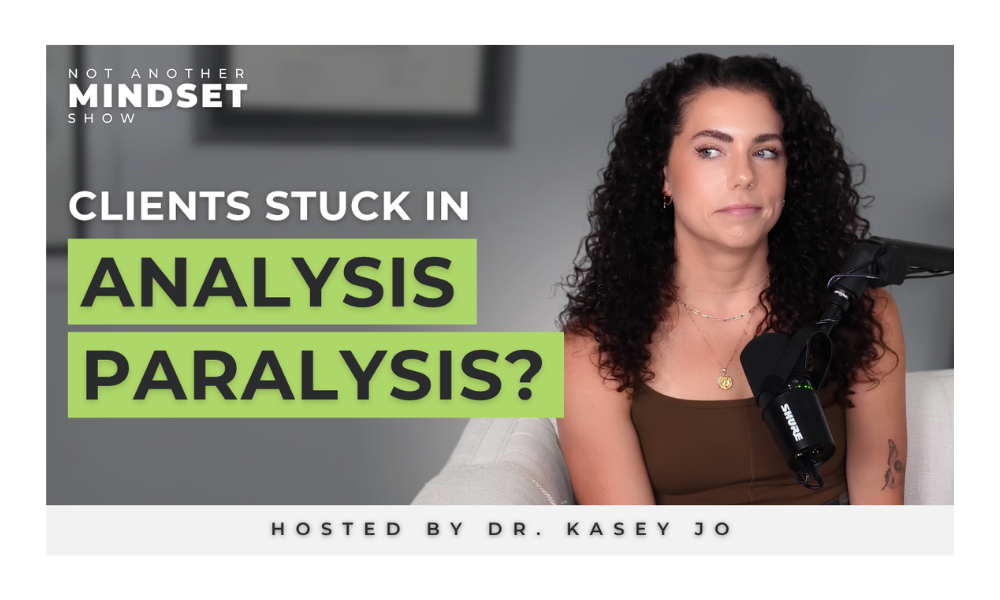
One of the best ways to help clients with analysis paralysis is to narrow their options instead of adding more.. When a choice feels wide open, people tend to freeze. A little constraint, like a narrower question, a specific prompt, or a short bounded experiment, gives them somewhere to start and makes it much easier to take action.
I want to start with a quick experiment. Think about a rubber band and come up with as many uses for it as you can. You’ll probably get to five or seven and then start thinking, “There’s gotta be more.”
Now try this instead. How many ways could you use a rubber band as a weapon? How many ways could you use one in your car? On your body? You can probably come up with far more ideas now, even though I just limited your thinking.
That’s the premise of this whole episode. If you’re a health or fitness coach, this matters for how you market, how you talk to prospective clients, and how you help current clients when they feel stuck.
What You’ll Learn in This Episode
- Why more options and total freedom can lead to analysis paralysis
- The three conditions where choice overload is most likely to show up
- How to help prospective clients make a confident decision about working with you
- How momentary restriction helps clients spot their own autopilot patterns
- Why autonomy and structure work together in good coaching
Why Do Too Many Options Lead to Analysis Paralysis?
Too many options can create a frozen feeling, a version of the classic analysis paralysis, and the way to break through it is to put some guardrails in place. We tend to believe more freedom and more possibilities are always the better route, but sometimes a limit is actually more supportive.
Journaling is a good example. You sit down with an open sheet of paper and you’re supposed to journal your thoughts, and a lot of times that feels like, “What the heck am I even supposed to write about?” But if I ask you to journal about something difficult you recently went through and what it taught you, suddenly you have a few directions to run with, and you could pretty easily fill a page.
I’ve played around with this on Instagram too. I’ve been posting consistently for somewhere around 12 to 14 years, and what I’ve learned is that the more specific the question box, the more answers I get. When it just says “Ask me anything,” people think, “Well, I don’t know, I could go so many directions.” When I change it to “Ask me a question that starts with how,” I get so many more questions, like how I take care of my curly hair or how I got into Formula One.
A little bit of constraint gives people a place to start.
When Are Clients Most Likely to Get Analysis Paralysis?
Analysis paralysis is most likely to happen when options are hard to compare, when you’re not sure what you want or what’s best for you, and when the decision feels high stakes. The research on what’s called choice overload suggests it doesn’t happen all of the time, and there are definitely situations where wide open freedom is helpful.
If you’re a coach or business owner, those three conditions probably sound familiar. If you want to help clients with analysis paralysis, think about the clients you work with when they’re trying to decide on a direction, or when you ask them, “What do you think is going to work here?” It depends on the person, but sometimes that open question is exactly what makes them stall.
How to Help Clients With Analysis Paralysis Before They Hire You
The best way to help prospective clients with analysis paralysis is to make it easy for them to compare your coaching to everyone else’s, speak to the specific transformation you’re best able to provide, and openly acknowledge that hiring a coach is a high stakes decision.
Think about everything your prospective clients are up against. Hire this coach, no that one, now there’s an app, now there’s an AI thing, maybe they’ll just try intermittent fasting again, or maybe they’ll buy someone else’s program. There are so many options, and they’re hard to compare.
So instead of “I can help you lose weight,” get deeper. Think about your person and help them see whether you’re the right fit. When you make that comparison easier, it either becomes very clear you’re not the right coach for them, or it becomes very clear that you’re exactly who they want to work with. That saves you DMs, consult calls, and follow-ups because you’re helping them build a more confident decision.
Why hiring a coach feels high stakes
A lot of people interested in working with you have already worked with other coaches, and it didn’t go well. That’s a risky decision to make again. Even a $37 program can bring up, “What if I don’t stick to it? What if it doesn’t work for me?”
It’s tempting to think, “If they really wanted my help, they would sign up.” But it’s a high stakes decision, honey. We have to help them see that we recognize that, and then lower the stakes and the risk factor in the best way we can.
What Is Momentary Restriction and How Does It Help Clients?
Momentary restriction is a coaching tool where, for a short and bounded period of time like three days, one week, or two weeks, a client removes (or adds) something. It’s not forever. It’s just long enough to collect more awareness and more data to work with.
I’ll give you an example from my own life. I kept dark chocolate in the freezer pretty much always, and I realized I was going through a bar every other day without even noticing. I didn’t want to swear it off, because we know severe restriction can make it feel like you need something even more. So I took it out of the freezer for two weeks and just paid attention.
What I learned had nothing to do with chocolate. My autopilot behaviors were running the show. After any meal I wanted something sweet. When I had five minutes between calls, I’d grab a piece. When I got antsy sitting at my desk, I’d get up and go get some. I wasn’t actively thinking any of that, and I had no idea those patterns were there until I kept opening the freezer drawer and finding nothing in it.
Taking the chocolate away didn’t fix anything on its own. What it did was show me what I was actually doing.
Why momentary restriction works with clients
It works because it isn’t forever, so a big unbounded problem like “I can’t stop reaching for the wine” or “I want to change my whole relationship with food” starts to feel doable. If a client wants to cut back on drinking, you might suggest removing alcohol from the house for two weeks and seeing what they learn.
It also builds self-knowledge. Instead of you telling a client what’s holding back their progress, they run the experiment and report back on the triggers, the cravings, and what’s underneath it all, which honestly you wouldn’t be able to figure out yourself as the coach. And they’re in charge of the whole thing.
Who momentary restriction isn’t right for
This isn’t a great tool for everybody. For clients with a history of disordered eating or an eating disorder, it’s probably not a good fit. Someone with no self-awareness practice yet probably won’t get much out of it either. Always bring it up as a conversation and an option, explain the why, and let them decide.
Does Giving Clients More Freedom Support Their Autonomy?
Giving clients unlimited options can feel like you’re supporting their autonomy, but it isn’t very good coaching. Real autonomy support was never supposed to be “here’s infinite choices, good luck.” It still means supporting someone with structure and helping them build the skills to make choices and take action on their own.
Autonomy and structure work together. The real enemies of autonomy are control and pressure. So stay away from control and pressure, and keep offering structure, guidance, and support. Any restraint you use should be something you offer, not something you impose.
Key Takeaways
- Too many options and total freedom can lead to analysis paralysis, and a little constraint often helps people come up with more ideas and take action.
- Choice overload is most likely when options are hard to compare, people aren’t sure what they want, and the decision feels high stakes.
- Helping prospective clients compare your coaching to other options makes it clear faster whether you’re the right fit.
- Hiring a coach is a high stakes decision for many people, especially if a past coach didn’t work out, and acknowledging that helps lower the risk.
- Momentary restriction is a short, bounded experiment that helps clients discover their own patterns instead of being told what’s wrong.
- Autonomy and structure work together, while control and pressure work against autonomy.
Frequently Asked Questions
Narrow their options. A specific prompt or a short, bounded experiment gives them somewhere to start. For prospective clients, make it easy to compare your coaching to other options and acknowledge that hiring a coach feels like a high stakes decision.
It can be, when it’s short-term and bounded. Momentary restriction removes or adds something for a few days to a couple of weeks so a client can collect awareness and data. The goal is to learn from it, not to swear something off forever.
Long enough to notice patterns, and no longer. Three days, one week, or two weeks are all reasonable windows, and afterward the client can go back to what they were doing if they want to.
It’s probably not a good fit for clients with a history of disordered eating or an eating disorder. People with no self-awareness practice yet also may not get much out of it. Offer it as an option in conversation rather than a directive.
If you want to help clients with analysis paralysis (or you’re feeling stuck yourself), try adding a guardrail instead of another option. Momentary restriction is one of the lessons in my 5 Free Lessons in Mindset and Behavior Change Coaching, so grab those if you want to go deeper.
Links & Resources
[FREE GUIDE] 5 Free Mindset & Behavior Change Lessons
Health Mindset Coaching Certification
Follow Dr. Kasey Jo on Instagram: @drkaseyjo
AUTHOR BIO
Dr. Kasey Jo Orvidas, PhD is a published mindset and health behavior change researcher with over a decade of health and fitness coaching experience. She is the founder of the mindset and behavior change coaching program: The Health Mindset Coaching Certification.
Research mentioned in this episode: