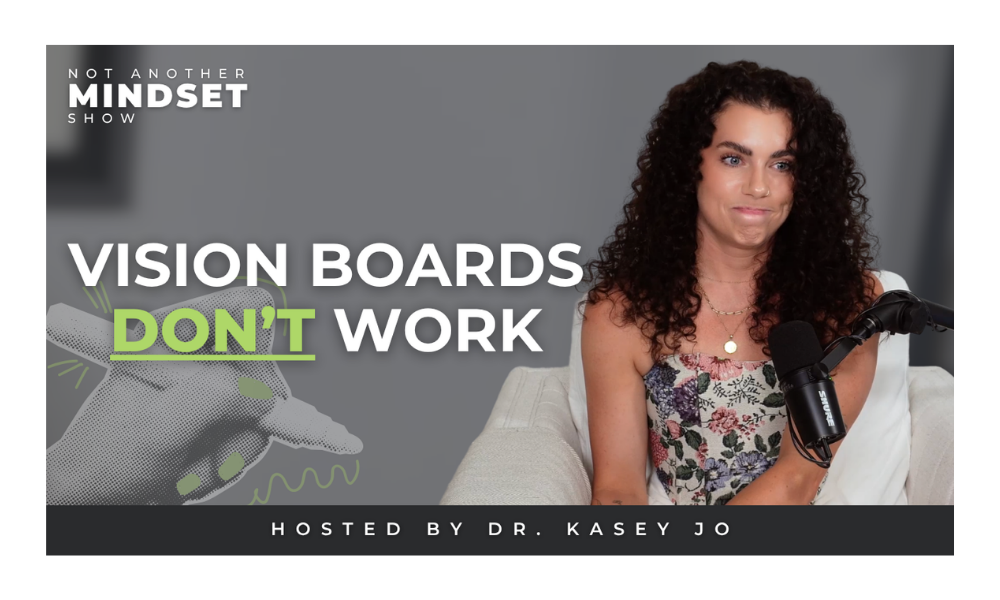
Do vision boards actually work? Research suggests the picture-perfect fantasy stage might work against you. Positive fantasies about achieving a goal can lower your energy and motivation to pursue it. That effect gets stronger the more the goal actually matters to you. Not exactly what you want to hear about the board sitting on your desk right now.
In this episode of Not Another Mindset Show, I’m breaking down the research on vision boards and positive fantasizing. I’ll cover the key difference between expectation and fantasy, why imagining your success can actually backfire, and what the research says works instead. I’ll also connect it to a tool I teach inside The Health Mindset Coaching Certification: mental contrasting, the evidence-based version of visualization that actually holds up.
If you made a vision board back in January and haven’t looked at it since, this one’s for you. No shame. No bonfire. Just the science.
What You’ll Learn in This Episode
- The real difference between expectation and fantasy, and why it matters for your goals
- What the research finds when people fantasize about a positive future
- Why the effect gets worse the more the goal actually matters to you
- The connection between fixed mindset and fantasy backfiring even harder
- What actually works instead (and it’s not throwing out your vision board)
Do Vision Boards Work? Here’s What the Research Actually Suggets
Short answer: probably not the way most people think. A vision board itself isn’t harmful. Sitting down with friends, cutting out pictures, and dreaming big can be genuinely fun. But research suggests the specific mental habit a vision board encourages (vividly imagining your goal as already achieved) can quietly work against you.
This comes down to a distinction most people never think to make: expectation versus fantasy.
Vision Boards and the Difference Between Expectation and Fantasy
An expectation is grounded in evidence. You’ve done hard things before, so you have a real reason to believe you can do this one too. A fantasy is different. It’s a pleasant mental image with no evidence attached. It feels good in the moment, but it isn’t built on anything real. That’s exactly why it’s called a fantasy.
Research suggests these two mental states produce almost opposite outcomes. Expectation tends to support follow-through. Fantasy tends to undermine it.
What the Research Suggets About Vision Boards and Positive Fantasizing
Kappes and Oettingen (2011) ran a set of experiments where participants generated positive fantasies about a future outcome. After fantasizing, participants reported less energy and less desire to actually pursue the goal. The researchers didn’t just ask how people felt. They measured blood pressure too, an indicator of physical readiness to act. Positive fantasizing lowered that readiness.
The effect got stronger, not weaker, when the goal genuinely mattered to the person. That’s the part worth sitting with. The more you actually want something, the more a vivid fantasy about already having it can sap your drive to go get it.
This isn’t limited to a lab setting either. Kappes, Oettingen, and Mayer (2012) found that students with more positive fantasies early on ended up with worse outcomes later: lower grades, more absences. This held true even after controlling for how capable the students actually were. The same research group found a similar pattern across other areas of life, including relationships and job searches, tracked over roughly two years.
Why Your Vision Board Might Be Working Against You
The leading explanation involves premature satisfaction. When you vividly imagine already having achieved a goal, your mind experiences some of the relaxation and satisfaction of already getting there, before you’ve done any of the actual work.
Think of it like eating the meal before you’ve cooked it. Your brain registers a version of completion. That registration can quietly reduce the urgency to do the work that would make it real.
Vision Boards and Fixed Mindset: A Risky Combination
Research also points to mindset as a moderating factor. People with more of a fixed mindset (the belief that abilities and outcomes are largely set) appear to get hit hardest by the downside of positive fantasizing. They showed the biggest drop in achievement and didn’t get much emotional benefit either.
A fixed mindset paired with heavy fantasizing looks like a worst-case combination: less real progress, and not even much of the relaxation payoff to show for it. There isn’t yet a specific study directly testing whether a growth mindset protects against this effect. But it’s a reasonable extension of what growth mindset research already shows about resilience and effort, and worth flagging as a connection rather than a settled finding.
What Actually Works Instead of a Traditional Vision Board
None of this means you should never picture your goals or feel excited about them. The version that holds up in the research is called mental contrasting, and it’s the foundation of the WOOP framework (Wish, Outcome, Obstacle, Plan) developed by Gabriele Oettingen.
Mental contrasting does include positive visualization, but it doesn’t stop there. You also identify the specific obstacles standing between you and the goal, and you build a plan for those obstacles before they show up. Naming what could realistically get in the way snaps your brain out of the fantasy state and back into reality. From there, if-then planning (implementation intentions) gives you a concrete plan for the moment an obstacle actually appears.
This is exactly the kind of tool set we teach inside The Health Mindset Coaching Certification, and it’s genuinely one of the most-used skills HMCC students take into their coaching. The goal isn’t to kill the dreaming. It’s to pair it with a plan honest enough to survive contact with reality.
Key Takeaways
- Do vision boards work? Research suggests the fantasy stage alone often works against you, even though the practice itself feels good.
- Expectation (grounded in evidence) and fantasy (a pleasant image with no evidence behind it) produce different, often opposite, outcomes.
- Positive fantasizing has been linked to lower energy and motivation to pursue a goal, and the effect grows stronger the more the goal matters.
- People with a more fixed mindset appear to get hit hardest by this backfire effect.
- Mental contrasting and the WOOP framework combine positive visualization with honest obstacle planning, which is the version supported by the research.
Frequently Asked Questions About Whether Vision Boards Work
Do vision boards actually work for achieving goals?
Research suggests the visualization process behind a typical vision board can work against you. Positive fantasizing about a future outcome has been linked to lower energy and motivation to pursue that outcome. The vision board itself isn’t the problem. The purely positive fantasy it often encourages is.
Is a vision board the same as expectation or fantasy?
An expectation is based on evidence: you’ve succeeded at something similar before, so you have real reason to believe you can again. A fantasy is a pleasant mental image with no evidence behind it. Research suggests expectation tends to support follow-through, while fantasy tends to undermine it.
Why might a vision board make you less likely to achieve your goal?
The leading explanation is premature satisfaction. Vividly imagining a goal as already achieved lets your mind register some of the relaxation of getting there before you’ve done the work. That registration can quietly reduce your motivation to actually do it.
Does a fixed mindset make the vision board effect worse?
Research suggests people with a more fixed mindset get hit hardest by the downside of positive fantasizing, showing bigger drops in real progress. A direct study testing whether a growth mindset protects against this specific effect doesn’t yet exist, but it’s a reasonable connection given what’s already known about growth mindset and resilience.
What should I do instead of a traditional vision board?
Try mental contrasting, the foundation of the WOOP framework (Wish, Outcome, Obstacle, Plan). Picture the outcome you want, then honestly identify the obstacles likely to get in your way, then build a specific plan for those obstacles. This combination is supported by research in a way that positive visualization alone is not.
Is it bad to make a vision board at all?
Not necessarily. Making a vision board with friends can be a fun, low-stakes activity, and that’s fine on its own terms. The research concern is specifically about relying on pure positive fantasizing as your actual strategy for achieving a goal, not about the activity itself.
Links & Resources
Evidence-Based Strategy to Help Clients Achieve Goals (The WOOP Method) | EP 29 — a full breakdown of the WOOP framework referenced in this episode.
Why Don’t My Clients Follow Through? The Intention-Behavior Gap Explained | EP 112 — more on if-then planning, the tool that pairs with mental contrasting.
Identifying a Fixed Mindset In Clients (And Coaches) | EP 53 — more on the fixed vs. growth mindset distinction referenced in this episode.
Health Mindset Coaching Certification
Follow Dr. Kasey Jo on Instagram: @drkaseyjo
AUTHOR BIO
Dr. Kasey Jo Orvidas, PhD is a published mindset and health behavior change researcher with over a decade of health and fitness coaching experience. She is the founder of the mindset and behavior change coaching program: The Health Mindset Coaching Certification.