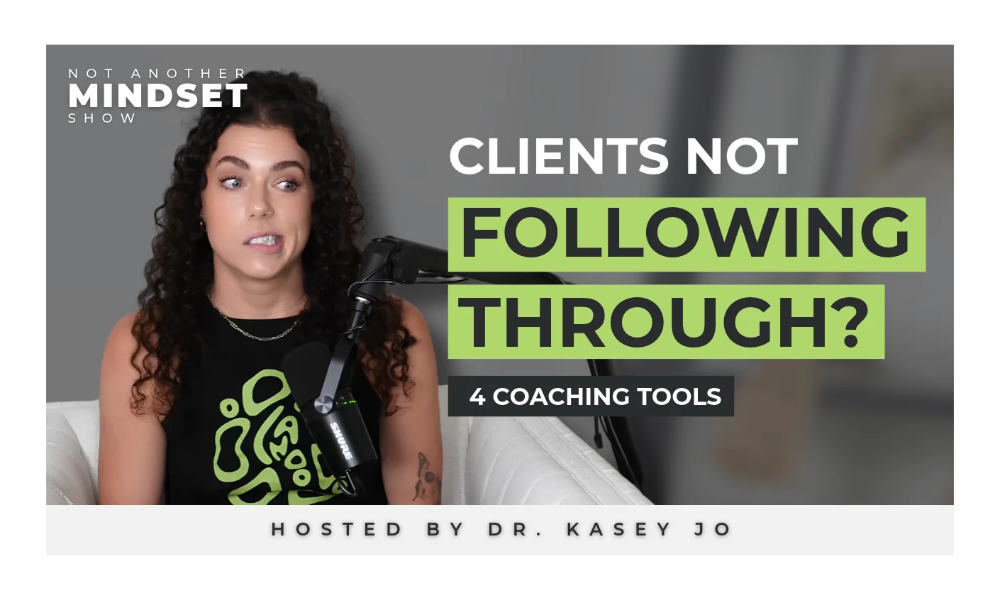
If you want to know how to get coaching clients to follow through, the answer usually isn’t more knowledge. Knowledge is not what drives adherence. Mindset, behavior change, communication, and relationship are. My GROW model gives you one tool for each, and every one of them comes down to talking less and uncovering more from within your client.
You know the client I’m talking about. They told you so clearly, so loudly, how badly they want to change. Then they can’t stick to the most basic parts of the plan, and you’re left thinking, “What do you mean? You just told me how much you want this.”
Or they build so much momentum for weeks, maybe even months, and then something happens and they fall off and struggle to get back on. Or they slowly stop saying as much to you, until everybody in the room knows they’re just waiting out their contract.
It sucks. And if you’re a coach who really cares about your clients, it can turn into “maybe I’m just not good enough” or “maybe I’m not cut out for this.” I want you to coach for as long as you want to coach, so let’s talk about what’s actually going on.
What You’ll Learn in This Episode
- Why being the most knowledgeable coach in the room won’t stop clients from falling off
- The four pillars of my GROW model: guidance, relationship, optimization, and wisdom
- The question I ask clients when I’m feeling really stuck with them
- Why you need to understand the benefits of the habit your client is trying to break
- Why asking permission before you give advice actually helps your expertise land
Why Don’t Clients Follow the Plan, Even When They Say They Want To?
Most of the time it has nothing to do with how badly they want it. Knowledge is not what drives adherence. Mindset, behavior change, communication, and relationship do.
I’ve seen this over and over again. Coaches with decades of experience, coaches who are also registered dietitians, still have 20 to 30% of their clients at any given time who aren’t seeing results and can’t stick with it. You can be the most knowledgeable coach in the room and still constantly watch clients fall off.
And listen, this is coming from someone who owns a certification business and has a PhD. I’ve been educated, okay? But I can’t tell you the number of registered dietitians and exercise physiologists who come into the Health Mindset Coaching Certification (HMCC) shocked, asking why they were never taught any of this.
We all love to nerd out on niche nutrition and fitness topics. None of it matters if your clients aren’t actually following through.
How to Get Coaching Clients to Follow Through With the GROW Model
The GROW model is the spine of everything I do. It’s how I coached my own clients, how I teach other coaches to coach, and everything inside HMCC runs through it. GROW stands for guidance, relationship, optimization, and wisdom.
The thread through all four is the same. Talk less, and work to uncover more from within your client. That is really the art of coaching.
Guidance: Why Ask Your Client What They’d Do If They Were the Coach?
Because your client has information you don’t. They know their life, their preferences, how they’re feeling, and what they actually want, so your job is less about installing solutions and more about helping pull them out.
Coaching and guiding are not the same thing. You can educate, hand someone a plan, and adjust their macros all day without ever actually guiding them. I tell my students all the time to act like a researcher or a detective, always trying to figure out what’s really going on.
If your frustration sounds like “my client just won’t follow the plan I gave them, so what’s the point of them even paying me,” the uncomfortable truth is that you’re kind of the problem. People don’t follow plans because you told them to. They follow a plan when they feel heard and feel like they were part of developing it, even, yes, my friend, if they paid you for said plan.
The tool: when you’re noticing patterns and feeling really stuck with a client, ask them, “Hey, humor me for a second. If you were the coach working with a client who was struggling the way you are, what would you say to them?” I know it feels backwards, because aren’t you the coach? But it can be really revealing, and your client might come up with a solution that works better for them than anything you could come up with yourself.
This isn’t something to use all the time. It’s for when you’re stuck.
Relationship: How Do You Get Clients to Open Up in Check-Ins?
You get clients to open up by caring about their life just as much as you care about whether they hit their protein target. Connection and trust are not soft extras. They’re some of the most core parts of effective coaching.
Especially in the age of AI, I really think your hottest commodity as a coach is actually being a human who knows how to connect with other humans.
If your clients don’t feel like they can be open with you, if they see you as an authority figure and they’re scared to tell you when something goes wrong, they’re going to hide things. No openness means no information for you, which means no results. So if your clients aren’t sharing with you and aren’t giving you anything to work with, you’ve got to look inside. I’m not going to say always, but more than likely it has nothing to do with your client and everything to do with the coaching relationship.
The tool: be just as serious about the non-fitness, non-nutrition things going on in your client’s life as you are about their traditional metrics. You can even systematize it. Put it in their check-in forms, or set a reminder to check in on someone every once in a while. I’ve had a roster of 60 clients before, and just like the other relationships in your life, you sometimes need a reminder.
I know it can feel inefficient when you’re just trying to update a plan and move on to the next client. But the stuff that drives behavior lives outside of macros and progressive overload. It’s in their life, their stressors, and their mindset, and you need a relationship with that person to actually access those things.
Optimization: Why Ask About the Benefits of a Habit Your Client Wants to Change?
Because there are benefits, otherwise your client wouldn’t be doing it in the first place. To coach someone well, you need to understand their reality, and that includes what they’re getting out of the habits they’re struggling to change.
We’re in the business of optimization, not just fixing problems. Not being unhealthy doesn’t somehow equal optimal health, because alleviating the negative doesn’t automatically create the positive. Your clients are not broken, and treating them like they need to be fixed all the time keeps the focus on what’s going wrong instead of what we can leverage that’s going right.
It’s really easy to look at a check-in and zero in on everything they didn’t hit this week. But I promise you, they already know what they’re not doing well enough. We don’t need to harp on it.
The tool: when a client is struggling to change, ask them about the good things that come from the thing they want to change. If they’re eating fast food five times a week and trying to cut back, ask what benefits they’re actually getting from it before you push them to stop.
Wisdom: Should Coaches Ask Permission Before Giving Advice?
Yes. Asking permission before you give suggestions or share solutions makes it so much more likely your advice will actually land.
You’re the expert on nutrition, fitness, or whatever your area is, but you are not the expert on your client. They’re the expert on themselves. And especially if you’ve been coaching for a long time and have seen a lot of patterns, it’s really easy to assume you know what someone needs, or that they’re just uncoachable.
That’s the righting reflex. As soon as a client is struggling, we rush in to fix it and tell them what to try next. Instead, slow down, sit on your hands, ask questions, try to understand, and help your client arrive at their own solutions.
The tool: ask permission before you share your knowledge or give a suggestion. I know it sounds wildly counterintuitive, because aren’t your clients paying you for your expertise? But unsolicited advice doesn’t usually land well, even in a coaching relationship. The person on the other end has a little bit of a recoil, like, “You don’t actually know what’s going on with me, so why do you think you know what’s best for me?”
Key Takeaways
- Nutrition and exercise knowledge tells you what works, but it is not what drives client adherence.
- Clients follow a plan when they feel heard and feel like they helped build it, even if they paid you for it.
- Asking a struggling client what they would do if they were the coach can bring out a solution that fits them better than yours.
- What drives your client’s behavior lives in their life, stressors, and mindset, not in their macros.
- Every habit your client is trying to change has benefits for them, and understanding those benefits is part of coaching the change.
- Asking permission before giving advice helps your expertise land instead of making your client recoil.
Frequently Asked Questions
A lot of the time it’s because the plan was handed to them instead of built with them. People follow a plan when they feel heard and feel like they were part of developing it. Telling someone what to do, even someone who paid you, usually isn’t enough on its own.
Not on its own. I’ve seen coaches with decades of experience, including registered dietitians, still have 20 to 30% of their clients not seeing results. Knowledge tells you what works, and the art is in how you communicate it so your clients actually follow through.
The righting reflex is the urge to jump in and fix a client’s struggle the second it shows up, by offering a solution or telling them what to try next. Slowing down, asking questions, and helping your client find their own solution usually works so much better.
Care about what’s going on in their life as much as their numbers, and make that obvious. Adding life questions to your check-in forms or setting reminders to check in on someone helps you keep the relationship going, even with a big roster.
The art of coaching is in how you communicate, so your clients finally follow through, even the ones other coaches would be quick to write off as uncoachable. If you’re ready to go deeper, join the waitlist for the Health Mindset Coaching Certification and get five free lessons, no strings attached. We only open twice a year, and our next enrollment is in February 2027.
Links & Resources
- Grab 5 Free Lessons in Mindset and Behavior Change Coaching [HMCC WAITLIST]
- Health Mindset Coaching Certification
- Follow Dr. Kasey Jo on Instagram: @drkaseyjo
- Not Another Mindset Show
AUTHOR BIO
Dr. Kasey Jo Orvidas, PhD is a published mindset and health behavior change researcher with over a decade of health and fitness coaching experience. She is the founder of the mindset and behavior change coaching program: The Health Mindset Coaching Certification.