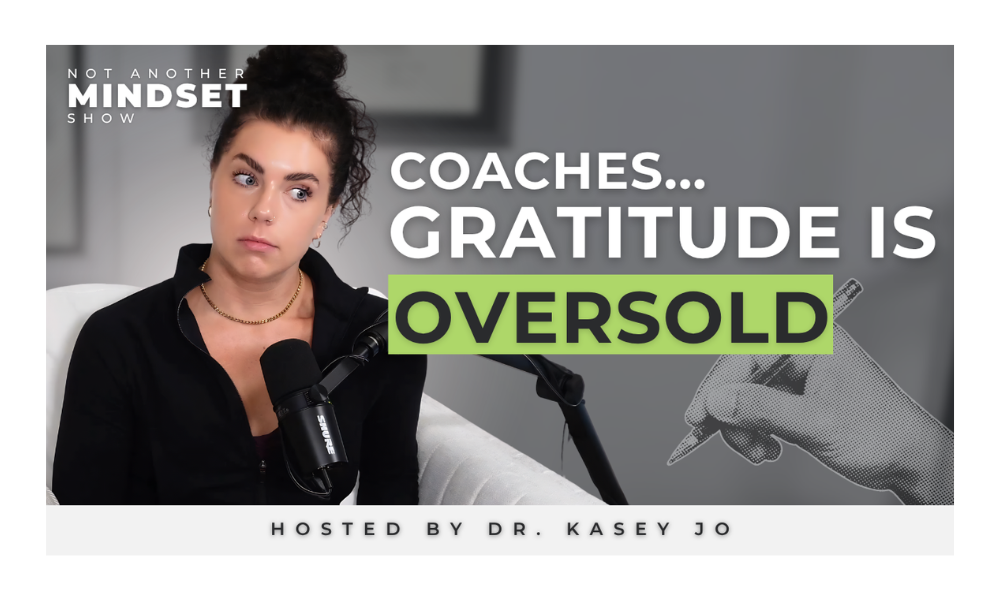
Does gratitude journaling actually work? Research suggests yes, but the effect is much smaller than most wellness content claims. A 2025 meta-analysis combining more than 140 studies and over 24,000 people found gratitude practices do improve wellbeing. The effect size, however, is small. Gratitude journaling isn’t a myth. It’s also not the life-changing habit the internet has sold you.
In this episode of Not Another Mindset Show, I’m breaking down a 2025 meta-analysis that surprised me. I’ll cover what effect size actually means, why this particular number is more trustworthy than most, and what it actually means for you if you coach clients on habits like this. I’ll also connect it to something I teach inside The Health Mindset Coaching Certification: why letting clients choose their own reflective practice usually matters more than which specific practice they pick.
If you’ve ever felt like gratitude journaling should be changing your life more than it actually is, this one’s for you.
What You’ll Learn in This Episode
- What a 2025 meta-analysis of 140+ studies actually found about gratitude practices
- What “effect size” means, and why this specific number is more trustworthy than most published research
- What gratitude practices help with, and where the evidence gets much weaker
- Why gratitude practices often lose their advantage compared to other active practices
- What this means for how you coach clients on habits like journaling
Does Gratitude Journaling Actually Work?
A 2025 paper combined data from more than 140 studies, covering over 24,000 people across 28 countries. The researchers wanted to know what gratitude practices actually do for wellbeing. Their answer: gratitude practices do increase wellbeing. The effect size, though, came out around 0.19. In plain terms, that’s a real result. It’s also a small one.
What Effect Size Actually Means (And Why It Matters for Whether Gratitude Journaling Works)
An effect size tells you more than whether two things are related. It tells you how strong that relationship actually is. A positive correlation on its own doesn’t say much. An effect size does.
Here’s why this particular 0.19 deserves your trust. Research has a well-known publication bias problem. Exciting, positive results tend to get published. Underwhelming results often don’t. Researchers on this 2025 paper checked for exactly that bias. They found the opposite pattern. Studies with null or unsupportive findings got published just as often, if not more. That means this small effect size isn’t a lowball number. It’s an honest one, built from a genuinely complete picture of the research.
Gratitude Journaling Works Compared to What?
Effect size isn’t the only question worth asking. The better question is: compared to what?
Gratitude practices show their strongest advantage compared to doing nothing at all. That comparison holds up well. But compare gratitude practices to another active practice, like general daily journaling, acts of kindness, or writing about your ideal future, and the advantage often shrinks or disappears completely. For heavier concerns like depression and anxiety, the evidence gets weaker still. One review specifically recommended reaching for interventions with stronger evidence than gratitude practices for those conditions.
Does Gratitude Journaling Work Better Than Other Habits? What Coaches Should Know
Here’s the coaching takeaway: don’t build your entire approach around gratitude practices, and don’t expect them to carry a client’s results on their own. But don’t throw them out either.
Research suggests gratitude sits alongside several other small, zero-cost reflective practices in roughly the same range of effectiveness. Acts of kindness. Writing about an ideal future. General journaling. None of these clearly outperforms the others by a wide margin.
That changes the coaching question. Instead of deciding which practice is theoretically best, help your client choose the one they’ll actually do. Autonomy matters here. A client who picks their own reflective practice is far more likely to stick with it than one who’s told, “do this specific thing.” Adherence beats theoretical perfection almost every time, and that’s true whether you’re talking about gratitude journaling or meal prep.
How to Use Gratitude Practices Without Overselling Them
Gratitude practices still have a place in coaching. Inside HMCC, we talk about reframing something as a gift rather than a chore, seeing “I get to do this” instead of “I have to do this.” That reframe can weave naturally into client communication and coaching conversations.
The problem was never gratitude practices themselves. The problem is marketing and social content turning a small, genuinely helpful habit into a promised cure-all. When a client journals three good things every morning and their life doesn’t transform, they can end up feeling broken over a tool that was only ever meant to be a small nudge, not a whole strategy.
Key Takeaways
- Does gratitude journaling actually work? Research suggests yes, but the effect size (around 0.19) is small, not the dramatic result wellness content often implies.
- This particular study checked for publication bias and found the opposite pattern, which makes the small effect size more trustworthy, not less.
- Gratitude practices show their clearest advantage compared to doing nothing. Compared to other active practices, that advantage often shrinks or disappears.
- Evidence for gratitude practices gets weaker for depression and anxiety specifically.
- Letting a client choose their own reflective practice, rather than prescribing gratitude specifically, tends to matter more for real-world adherence.
Frequently Asked Questions About Whether Gratitude Journaling Works
Does gratitude journaling actually work for improving wellbeing?
Research suggests it does, but the effect is small. A 2025 meta-analysis of more than 140 studies and over 24,000 people found an effect size around 0.19 on wellbeing. That’s a real, meaningful result, just far smaller than most wellness content implies.
What is effect size, and why does it matter for gratitude research?
Effect size measures how strong a relationship actually is, not just whether it exists. A small effect size (like 0.19) means gratitude practices are genuinely linked to better wellbeing, but the size of that improvement is modest rather than dramatic.
Is gratitude journaling better than doing nothing?
Yes. Research suggests gratitude practices show their clearest advantage when compared to doing nothing at all. That comparison holds up consistently across the research.
Does gratitude journaling help with depression or anxiety?
The evidence is weaker here. Research suggests gratitude practices show a smaller benefit for depression and anxiety specifically, and one review recommended using interventions with stronger evidence for those conditions instead.
Is gratitude journaling better than other practices like acts of kindness or general journaling?
Not clearly. Research suggests gratitude’s advantage often shrinks or disappears when compared to other active practices, such as general journaling, acts of kindness, or writing about an ideal future. These practices land in a similar range of effectiveness.
Should coaches recommend gratitude journaling to clients?
Gratitude journaling can still help, but research suggests it shouldn’t be the centerpiece of a coaching strategy. Letting a client choose a reflective practice they’ll genuinely stick with, gratitude or otherwise, tends to matter more for real results than which specific practice they pick.
Links & Resources
Do Vision Boards Work? What the Research Actually Says | EP 113 — another look at a popular wellness practice that doesn’t hold up quite the way the internet claims.
Why Don’t My Clients Follow Through? The Intention-Behavior Gap Explained | EP 112 — more on why adherence matters more than picking the theoretically perfect strategy.
The ABCs of Behavior Change | EP 20 — more on autonomy and self-determination theory, referenced in this episode.
Health Mindset Coaching Certification
Follow Dr. Kasey Jo on Instagram: @drkaseyjo
AUTHOR BIO
Dr. Kasey Jo Orvidas, PhD is a published mindset and health behavior change researcher with over a decade of health and fitness coaching experience. She is the founder of the mindset and behavior change coaching program: The Health Mindset Coaching Certification.