Is NLP real or pseudoscience? Research suggests it’s mostly the latter, at least as a packaged system. Neuro-linguistic programming’s foundational claim, that eye movements reveal a person’s preferred sensory channel, has been tested directly and failed to hold up. Reviews of the broader research base find the same pattern. Some pieces of NLP are genuinely useful. NLP as a system is not well supported.
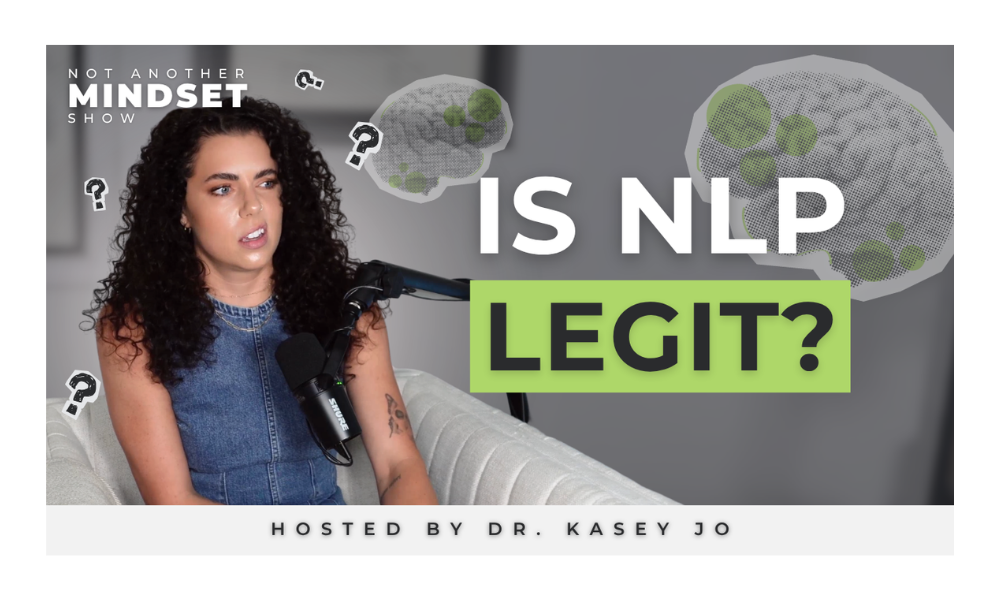
In this episode of Not Another Mindset Show, I’m answering a question I get asked constantly: is NLP real or pseudoscience, and does it belong anywhere near evidence-based coaching? I’ll walk through what NLP actually claims, what the research finds when those claims get tested, and which pieces of NLP are worth keeping (they exist, they’re just not unique to NLP). I’ll also connect it to how I think about vetting any certification, including The Health Mindset Coaching Certification.
If you’ve ever wondered whether you should spend money on an NLP certification, this one’s for you.
What You’ll Learn in This Episode
- What neuro-linguistic programming actually claims, and where it came from
- Why NLP’s foundational claim has been tested directly, and what researchers found
- What multiple large reviews of the NLP research base actually conclude
- What the evidence says about NLP specifically for health and coaching outcomes
- Which parts of NLP are genuinely useful (and where they actually come from)
- Three questions to ask before buying any coaching certification
Is NLP Real or Pseudoscience? Here’s What the Research Suggests
Short answer: pseudoscience, at least as a packaged system. Neuro-linguistic programming makes some genuinely testable claims. When researchers tested them, those claims mostly didn’t hold up. That doesn’t mean everything inside NLP is worthless. It means the “neuro” branding is doing work it hasn’t earned.
What Does NLP Actually Claim?
NLP emerged in the late 1970s. Its creators, including a linguistics professor, studied a handful of highly effective therapists at the time. Their idea: reverse-engineer what those therapists were doing and package it into a teachable method. That instinct wasn’t a bad one.
The foundational claim goes like this. Every person has a preferred representational system, meaning they process the world primarily through visual, auditory, or feeling-based channels. A coach or therapist can supposedly identify which system someone prefers by watching their eye movements, then match language to that system to build rapport and influence.
This claim is specific enough to test. That’s actually a point in NLP’s favor compared to vaguer wellness claims that can never really be proven wrong.
Is NLP Real or Pseudoscience? Why the Foundational Claim Doesn’t Hold Up
Researchers have tested the eye-movement claim directly. Wiseman and colleagues (2012) coded people’s eye movements while they told the truth or lied, then checked whether eye direction actually predicted which was which. It didn’t. A second phase taught one group the NLP eye-movement rules and left another group uninformed. Both groups performed the same at detecting lies. The researchers’ own conclusion: this pseudoscientific claim can be reliably dismissed.
This isn’t one lone study either. Earlier reviews (Sharpley, 1984, 1987; Heap, 1988) already found little support for the representational-systems idea. Across roughly 44 papers spanning two separate reviews, only a small number showed any positive support.
A separate, larger analysis went through the entire NLP research base: 315 articles, 63 of them peer-reviewed. Witkowski (2010) found that once purely descriptive articles were excluded, only about 18% of the remaining research supported NLP. Over half came back flat-out non-supportive. The paper’s own conclusion described NLP as pseudoscientific and recommended it be abandoned.
There’s also a useful outside check: Norcross and Koocher (2006) surveyed 101 leading psychologists and asked them to rank the most discredited interventions in mental health. NLP landed 18th on that list, which sounds almost respectable until you see what it beat. NLP ranked as more credible than angel therapy, crystal healing, and dolphin-assisted therapy.
Is NLP Pseudoscience for Health and Fitness Coaching Specifically?
Broader psychology research is one thing. What about coaching and health outcomes specifically?
A systematic review (Sturt et al., 2012, published in the British Journal of General Practice) searched for experimental studies on NLP for health outcomes. It started with nearly 1,500 studies and filtered down to a small number rigorous enough to count. Their conclusion, stated carefully: there is currently insufficient evidence to recommend NLP for any individual health outcome. That’s an absence of evidence, not proof that NLP fails. Worth noting: the NHS reportedly spent over £800,000 on NLP-related training over three years, mostly for administrative staff, despite that evidence gap.
A coaching-specific review (Passmore & Rowson, 2019, International Coaching Psychology Review) reached a similar conclusion for coaching contexts directly: the practices unique to NLP are poorly supported by the evidence.
If NLP Is Pseudoscience, Why Does Part of It Feel Real?
None of this means NLP contains nothing useful. Building rapport, asking genuinely open questions, listening in a way that makes someone feel understood, and recognizing that each person operates from their own internal map of reality: these things work. There’s real evidence behind them.
Here’s the catch. None of that evidence belongs to NLP. It comes from decades of communication science and motivational interviewing research, the same body of research behind a lot of what gets taught inside The Health Mindset Coaching Certification. NLP didn’t discover rapport-building or perspective-taking. It borrowed well-established communication skills, bundled them with untested claims about eye movements and representational systems, and packaged the whole thing under a name that sounds like neuroscience without actually offering any explanation at the neuronal level.
If something inside NLP has worked for you or your clients, that tracks. You were likely using genuinely evidence-based communication skills. NLP just wasn’t the thing that made them work.
Real, Pseudoscience, or Somewhere Between? Three Questions to Ask Before Buying Any Certification
Before spending money on NLP, or any other certification promising a coaching edge, ask three questions:
- Is the claim actually testable? Vague claims that can never be proven wrong (“raise your vibration”) aren’t a good sign.
- Who tested it, and did they have something to sell? Research from people without a financial stake in the outcome carries more weight.
- Was it tested in a context like yours? Evidence from real coaches working with real clients on real outcomes matters more than evidence from an unrelated setting.
Key Takeaways
- Is NLP real or pseudoscience? Research suggests NLP as a full system leans heavily toward pseudoscience, though the question deserves more nuance than a flat yes or no.
- NLP’s foundational claim, that eye movements reveal a preferred sensory channel, has been tested directly and did not hold up (Wiseman et al., 2012).
- Larger reviews of the NLP research base (Witkowski, 2010; Sharpley, 1984/1987; Heap, 1988) found limited support, and a survey of 101 psychologists ranked NLP among the most discredited interventions in mental health.
- A systematic review found insufficient evidence to recommend NLP for any individual health outcome (Sturt et al., 2012), and a coaching-specific review reached a similar conclusion (Passmore & Rowson, 2019).
- The genuinely useful parts of NLP (rapport, open questions, understanding a client’s perspective) come from communication science and motivational interviewing, not from NLP itself.
Frequently Asked Questions About Whether NLP Is Real or Pseudoscience
Is NLP real or pseudoscience?
Research suggests NLP, as a packaged system, is best described as pseudoscience. A coaching-specific review (Passmore & Rowson, 2019) found that the practices unique to NLP are poorly supported by evidence. Some communication skills associated with NLP are genuinely useful, but they come from established research outside of NLP.
Is NLP’s foundational claim real or pseudoscience?
NLP’s foundational claim is that eye movements reveal a person’s preferred sensory channel (visual, auditory, or feeling-based), and that matching language to that channel builds rapport. Wiseman and colleagues (2012) tested this directly and found it did not hold up, concluding the claim can be reliably dismissed as pseudoscience.
Is NLP pseudoscience when it comes to health outcomes?
A systematic review (Sturt et al., 2012) searched nearly 1,500 studies on NLP and health outcomes and found insufficient evidence to recommend NLP for any individual health outcome. This reflects an absence of strong evidence rather than proof that NLP doesn’t work at all.
Do researchers think NLP is real or pseudoscience?
Views vary, but multiple large reviews lean toward pseudoscience. Witkowski (2010) reviewed 315 articles and found only about 18% of peer-reviewed research supported NLP, ultimately describing it as pseudoscientific. A survey of 101 leading psychologists (Norcross & Koocher, 2006) ranked NLP among the most discredited mental health interventions.
If NLP has worked for me or my clients, was that a fluke?
Not necessarily. Research suggests the parts of NLP that tend to work, like rapport-building and open questioning, come from well-established communication science and motivational interviewing, not from anything unique to NLP. If NLP helped you, you were likely using those underlying, evidence-based skills, not the pseudoscience layered on top.
How do I know if a coaching certification or method is legitimate, or just well-branded pseudoscience?
Ask whether its core claims are actually testable, whether it was evaluated by researchers without a financial stake in the results, and whether it was tested in a context similar to your own coaching work. Certifications that can point to independent, context-relevant evidence are a safer bet than ones relying on testimonials alone.
Links & Resources
Why Don’t My Clients Follow Through? The Intention-Behavior Gap Explained | EP 112 — more on the evidence-based tools HMCC teaches instead of unproven branded methods.
Do Vision Boards Work? What the Research Actually Says | EP 113 — another look at a popular practice that doesn’t hold up quite the way it’s marketed.
Does Gratitude Journaling Actually Work? What a 140-Study Meta-Analysis Found | EP 114 — same evidence-first approach applied to another popular wellness practice.
Health Mindset Coaching Certification
Follow Dr. Kasey Jo on Instagram: @drkaseyjo
AUTHOR BIO
Dr. Kasey Jo Orvidas, PhD is a published mindset and health behavior change researcher with over a decade of health and fitness coaching experience. She is the founder of the mindset and behavior change coaching program: The Health Mindset Coaching Certification.